A Different Game, The Same Eyes
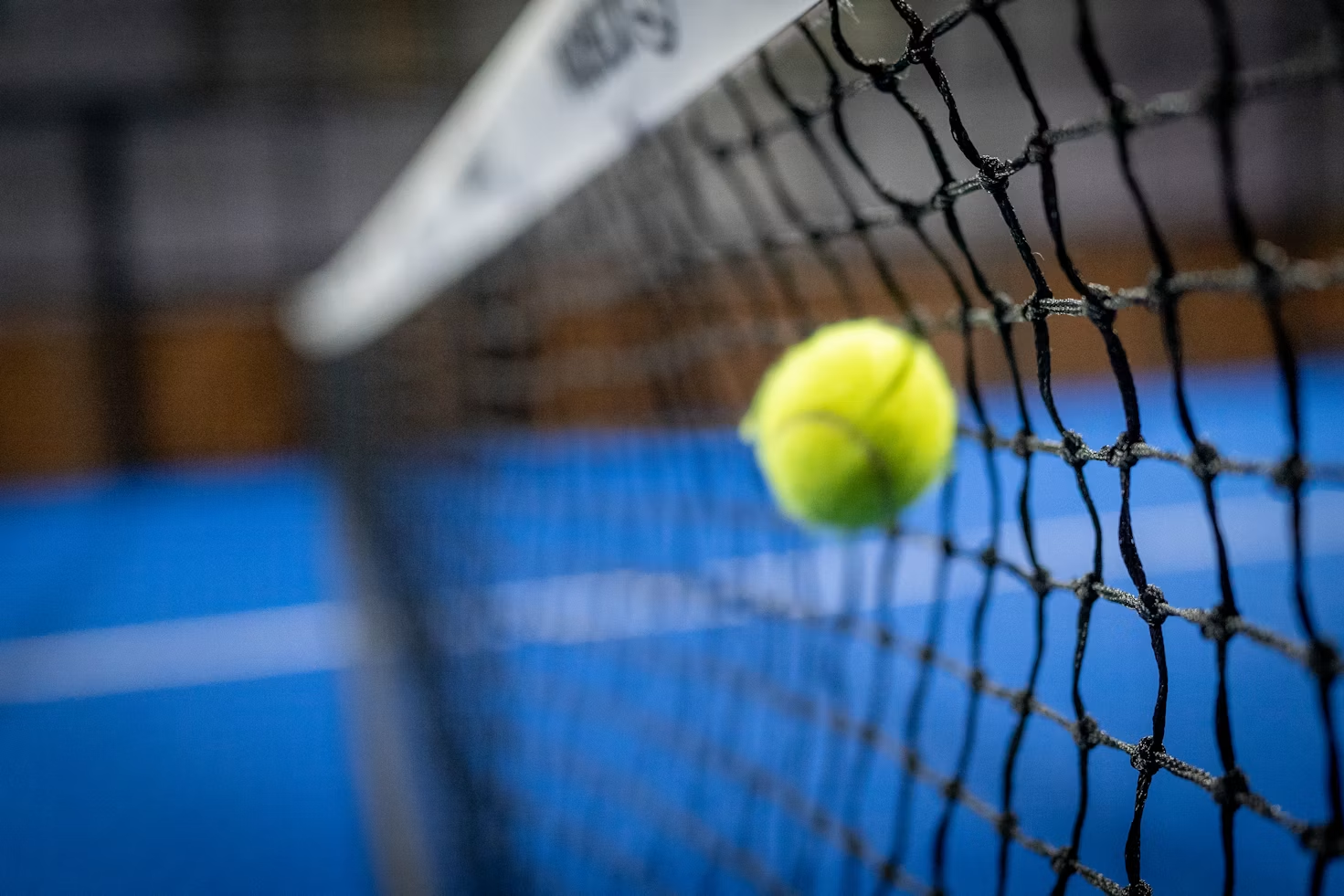
The first time a footballer steps onto a padel court, something slightly strange tends to happen.
They look like they have done this before.
Not the technique — the grip is wrong, the swing is unfamiliar, the overhead is a work in progress. But the movement is right. The positioning is right. The reading of where the ball is going before it gets there is right. Experienced padel players watching from the outside notice it almost immediately. The footwork looks trained. The anticipation looks automatic. The court sense looks like something that took years to build.
It did. Just not on a padel court.
The Transfer Nobody Planned
Padel is the fastest growing sport in the world. From 25 million players in 2020 to over 25 million in Europe alone by 2024, with new courts appearing in cities that had never heard of the game five years earlier. And running through its growth, like a thread you notice once you look for it, is an extraordinary concentration of professional footballers.
Gerard Piqué did not just take up padel after retiring from Barcelona. He co-founded the Premier Padel tour — the sport's elite professional circuit — and has become one of its most prominent figures, channelling the same competitive intelligence that made him a world champion into building the infrastructure of an entirely different sport. Neymar plays regularly and visibly. Messi, Sergio Ramos, Karim Benzema, Vinicius Jr — the list of elite footballers with a serious padel habit is long and continues to grow.
This is not coincidence. And it is not simply that footballers are athletic and athletic people pick up new sports quickly. The connection is more specific than that. Football builds a set of cognitive and physical skills that padel rewards almost immediately — skills that take years to develop through any other path, and that arrive fully formed in anyone who has played football seriously.
What Football Actually Builds
The obvious transfer is footwork. Thousands of hours of lateral movement, directional changes, weight shifting — football players arrive on a padel court with movement patterns already grooved that most padel beginners spend months developing. The split step, the recovery run, the ability to change direction without losing balance — none of it needs to be taught to someone who has been doing it since childhood. Watch Chingotto move around the court and you are watching football footwork expressed in padel — fluid, efficient, always in position before the ball arrives. That quality is not taught in padel academies. It is carried in from somewhere else.
But the deeper transfer is what researchers call perceptual learning — the long-term change in perception that results from thousands of hours of practice in a complex, unpredictable environment. Football does not just train the body. It trains the eyes and the brain to extract meaningful information from a moving scene faster and more accurately than an untrained observer. The footballer who has spent years reading defensive lines, tracking runs, and anticipating where the ball will land has developed a perceptual system that is fundamentally different from someone who has not.
Galán makes this visible at the highest level. His nickname — el extraterrestre, the alien — is the padel world's way of acknowledging that his perceptual system is operating at a level most people cannot follow. The angles he reads, the glass he uses, the positions he occupies before the ball arrives — none of it looks physically possible until you understand that he is not reacting to what is happening. He is responding to what he already knew was going to happen. That is perceptual learning at its most developed form.
On a padel court, this perceptual system activates almost immediately. Reading where the ball will go after it hits the back glass, anticipating the opponent's angle before they strike, positioning correctly before the situation demands it — these are perceptual tasks that the football-trained brain has been solving in different configurations for years. The environment is new. The underlying process is not.
Psychologists describe this through contextual interference theory — the finding that skills learned in variable, unpredictable environments transfer better than those learned in controlled, repetitive ones. Football is one of the most chaotic learning environments that exists. No two situations are identical. No outcome is guaranteed. Every session presents new configurations of players, space, pace, and pressure. That variability — which makes football hard to learn — is precisely what makes football skills so portable. The brain trained to adapt constantly adapts to a new court faster than a brain trained to repeat the same controlled movements.
The Wall as a Teammate
The back glass is the single most counterintuitive element of padel for most new players. The instinct, learned from everyday spatial experience, is to treat the ball's contact with the wall as the end of the rally — to expect the point to be over when the ball hits the back. In padel, the wall is the beginning of the next opportunity. The ball comes off it with pace and angle, and the player who reads that angle correctly and positions themselves before the ball arrives wins the exchange.
Football players adapt to this quickly because they already think in terms of using the environment rather than fighting it. The full-back who uses the touchline as a defensive tool, angling their pressure to force the winger toward the line rather than inward. The striker who uses the goalkeeper's position to determine where to place the shot. The wall is not an obstacle. It is a variable in the geometry of the situation — one more surface that changes the direction and pace of the ball, requiring the same spatial calculation football has been demanding for years.
In practice this means footballers develop wall play faster than almost any other group of newcomers. Not because they are more talented, but because the underlying mental model — use the environment, do not fight it — is already installed.
The Partnership Problem
Padel is a doubles sport. Four people on a court, split into two pairs, working as units. And this is where footballers find their most natural home.
The communication, the positioning relative to a partner, the instinct to cover space your partner has vacated, the unspoken understanding of who takes which ball — all of it replicates the dynamics of a football partnership. Coello at the net is the explosive striker — instinctive, reactive, finishing opportunities before defenders can adjust. Tapia behind him is the organiser, the one who reads the situation and has the bravery to take the difficult shot when the point needs to be won. Their partnership in Rome — clinical, composed under a 7-6 second set tiebreak — is exactly what football builds. Not just individual skill. The ability to function as a unit under pressure, to trust without checking, to cover without being asked.
Tennis players arrive with a different set of advantages — stroke production, racquet feel, timing of contact, understanding of spin and pace — that football players genuinely lack early on. The technique gap is real and takes time to close. But the doubles dimension adds a layer that tennis players and football players navigate differently. Neither is better overall. They are different strengths arriving from different directions. The footballer who acquires racquet technique and the tennis player who absorbs court sharing dynamics end up converging on the same place. The routes there are just different.
Why the Obsession Makes Sense
For professional footballers, padel solves a specific problem: what do you do with your competitive instinct when the competitive outlet is not available?
Football at elite level is physically punishing in ways that accumulate over a career. Knees, ankles, hips — the body that spent fifteen years absorbing the demands of professional football does not respond well to the same demands at 35. Padel is lower impact, smaller court, less explosive loading. It provides the competitive structure — the score, the point, the win — without the physical cost. For a body that needs to stay active but cannot sustain the training loads of elite football, padel is the sustainable alternative.
It is also social in a way that golf — the traditional footballer's leisure sport — is not. You play with people. You communicate, strategise, win and lose together. The dressing room dynamic does not disappear at retirement. It relocates to the padel court.
And the improvement curve is addictive. The footballer who arrives on a padel court and finds themselves reading the game almost immediately experiences something most new sports do not provide — the feeling of being competent earlier than expected. Competence feels good. Rapid improvement feels better. The faster you get better, the more you want to play. Football's cognitive gift to padel players is not just that they perform well. It is that they experience progress quickly enough to fall in love with the sport before the novelty wears off.
Same Brain, Different Court
What the football-to-padel transfer really illustrates is something broader about how skills work.
We tend to think of sports as distinct — different rules, different equipment, different physical demands. And at the surface level they are. But underneath the surface is a layer of cognitive and physical competency that does not belong to any single sport. Spatial intelligence. Movement efficiency. Anticipation. Partnership dynamics. The ability to read a situation before it becomes obvious.
These are not football skills or padel skills. They are human skills, developed in one context and available for transfer to any context that rewards them. Football builds them at scale, across years, through the kind of variable, unpredictable environment that contextual interference theory identifies as the most fertile ground for transferable learning. The player who steps onto a padel court for the first time and finds themselves already reading it is not discovering a talent for padel. They are discovering that football gave them something more transferable than they knew.
The court is new. The brain has been here before.