The 12 Yards Pressure Test
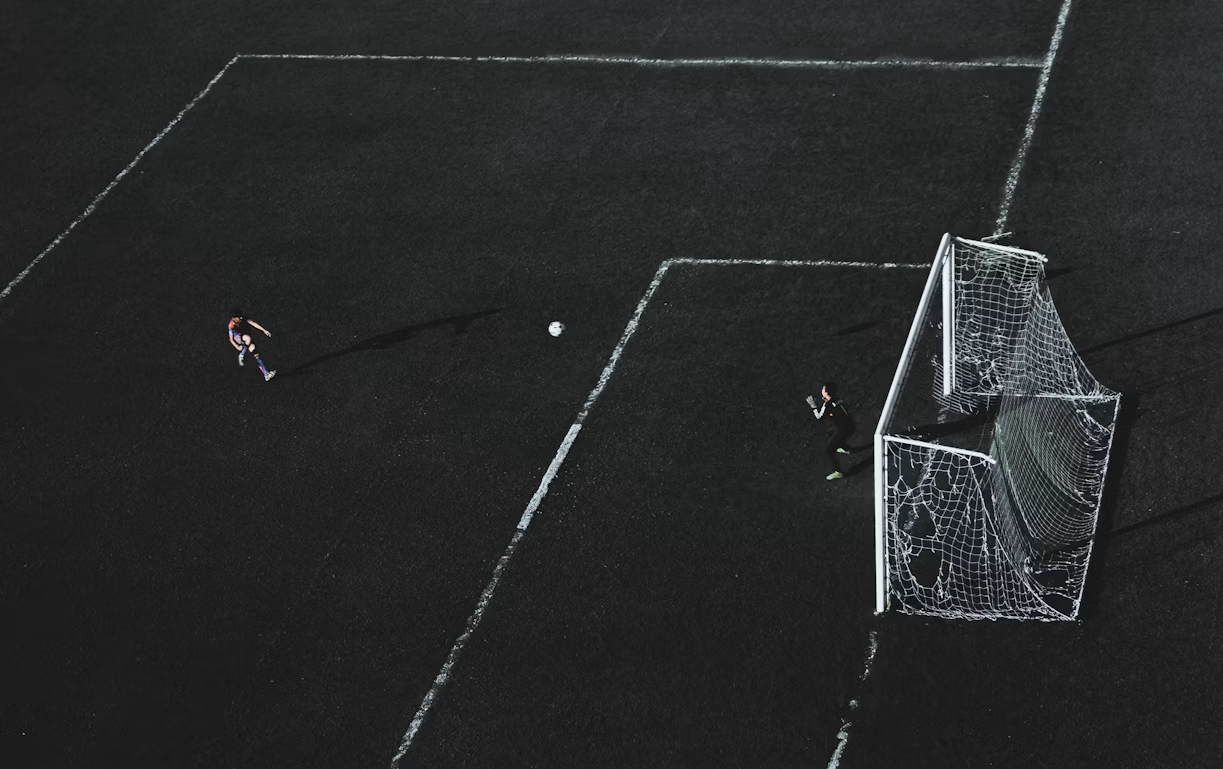
The keeper had already started walking away when I put my hands on my waist.
A second before that, they were on my hair. That involuntary reach — fingers to the back of the head, the body's way of processing something the mind hasn't caught up with yet. Then the hands came down. Settled at the waist. I stood there, twelve yards from an empty goal, and just absorbed it.
It wasn't a big moment by most measures. Seven-a-side, recreational league, weekend under floodlights. We were already qualified for the knockout stage regardless of the result. The penalty would have been style points — a perfect season, all wins, a full stop at the end of a sentence that was already complete. Nothing was truly at stake.
And yet standing there, hands on waist, it felt like everything.
That gap — between what was objectively at stake and what it felt like — is the most honest thing I can tell you about pressure. It is almost never about the actual consequences. It is about the story you tell yourself about what this moment means. And in the space between placing the ball and the referee's whistle, I had told myself a very specific story.
The Captain Picked Up the Ball
I should explain how I ended up there.
I was a central defender. My job, the thing I had built my entire identity on in that team, was keeping things out. Organising. Reading danger before it arrived. My stated goal for every match — literally, the metric I used to evaluate myself — was a clean sheet. Goals were someone else's department.
Our striker was injured. The penalty came in the last minute of injury time. I looked around and nobody moved. The winger looked at the floor. The midfielder suddenly needed to retie his boot. The striker was already on the sideline.
I picked up the ball.
The winger looked up when I handed it to him. He shook his head. You take it.
So I did.
Before I placed the ball, the referee came over. He said — and I remember this clearly — this will be the last kick of the game. No more time after this. I already knew that. But hearing it said out loud, in that specific moment, with the ball in my hand, was a completely different experience from knowing it abstractly. The words landed somewhere physical.
I put the ball down. I stepped back. I thought: just hit it hard, down the middle.
In training I am fine going to the corners. I have done it hundreds of times. My feet know where to put it. But in that moment, with the referee's words still reverberating, with my teammates watching, with the keeper bouncing on his line — my brain made a different calculation. The middle felt safer. More direct. Less room for error.
The keeper saved it.
I stood there. Hand to hair first — the involuntary thing, pure unfiltered regret, the body ahead of the mind. Then the hands came down to my waist. My teammates consoled me. I knew they had expected me to score.
Why The Brain Betrays You
Here is what was happening in my body in those few seconds, even though I had no language for it at the time.
The moment the referee spoke, my brain registered threat. Not consciously — there was no deliberate decision to treat a recreational penalty as a crisis. But the body does not distinguish between types of pressure with any precision. The same cortisol spike that helped our ancestors respond to physical danger fired in response to a man in a black shirt telling me this was the last kick of the game. Heart rate up. Breathing shallower. Muscles tensed. Vision narrowed.
That last one is worth staying on. Under acute stress, human peripheral vision literally contracts. The world gets smaller. The goalkeeper got bigger. The goal, research shows, is perceived as physically smaller under pressure than it appears in training — not as metaphor, but as measurable neurological reality. The twelve yards I had walked in training hundreds of times felt like a different distance. Because to my brain, in that moment, it was.
And then the thinking started. Psychologists call it paralysis by analysis — the phenomenon where conscious thought interferes with motor skills that have been so thoroughly trained they should be automatic. The more you think about where to put the ball, the more you disrupt the physical memory that already knows. Elite players are actually more vulnerable to this than amateurs, not less, because their technique is so deeply internalised that deliberate conscious interference creates more disruption, not less.
I knew how to take a penalty. My feet knew. My training knew. But under acute pressure, I stopped trusting what I knew and started thinking. And thinking, in that moment, was the enemy.
Research on penalty takers shows that players who take longer to place the ball score at a lower rate than those who are decisive. That players who look at the goalkeeper before shooting are more likely to miss than those who commit to a corner and don't look. That the direction a goalkeeper dives is often influenced by the taker's body language in the run-up — information the keeper processes unconsciously, before the kick is even taken.
In other words: the goalkeeper wasn't just saving a penalty. They were reading a story my body was already telling.
I had decided to go down the middle not because it was the better option. I had decided to go down the middle because my brain, under the specific pressure of that moment, defaulted to the most direct path. It felt like a decision. It was closer to a surrender.
The Most Human Moment in Sport
Roberto Baggio missed the penalty that cost Italy the 1994 World Cup final. He was the best player in the world at the time. He had carried Italy to that final almost single-handedly, scoring five goals in the tournament. He walked up to the spot and blazed it over the bar. The image of him standing there afterwards — head bowed, hands on his shorts, eyes closed — became one of the most recognisable photographs in sporting history.
Gareth Southgate missed a penalty in the semi-final of Euro 96 that eliminated England. He was 25. The miss followed him for decades — referenced in every England tournament campaign, attached to his name like a footnote. When he became England manager twenty years later, he took the team to a World Cup semi-final and two European Championship finals. He never publicly stopped carrying the 1996 miss. He just carried it differently.
That distinction — between a miss that defines you and a miss that just happened — is the whole thing. It is not about football. It is about whether you let a single moment become the story you tell about yourself.
Nothing Was At Stake. Everything Felt At Stake.
I have thought about why that penalty felt so significant when objectively it wasn't.
We were already qualified. A draw was fine. The season was complete. And yet standing over the ball, I felt the weight of every person watching, every expectation, the referee's voice, the keeper's eyes. The pressure was entirely self-generated. Nobody imposed it. I constructed it myself, in the seconds between placing the ball and beginning my run-up.
This is what the research on pressure actually shows: the external stakes rarely match the internal experience. People perform poorly in job interviews not because the consequences are catastrophic but because the story they have told themselves about the moment is catastrophic. The exam feels final not because life actually ends with a bad grade but because the mind has framed it that way. The penalty feels like everything because you decided, somewhere between the referee's whistle and your run-up, that it was.
The cruelest part is that the decision is unconscious. You do not choose to inflate the stakes. The brain does it for you, helpfully, in the service of making you take the moment seriously. The same mechanism that helps humans perform under genuine life-or-death pressure misfires in the context of a seven-a-side league match and makes a recreational penalty feel like a referendum on your character.
There is also something specific about being the captain. About being the person who picked up the ball when nobody else would. I had not taken the penalty because I was the best option. I had taken it because stepping forward was what the moment required and nobody else stepped. That is a different kind of pressure from the pressure of being chosen — it is the pressure of choosing yourself, and then having to live with that choice publicly.
Leadership adds a cognitive layer that individual pressure doesn't. When you step forward as captain, you are not just managing your own performance. You are simultaneously managing the perception your team has of you, in real time, while also trying to execute a technical skill that requires complete mental clarity. The two things are in direct competition. The part of your brain monitoring how your teammates see you is using resources the part of your brain that knows how to take a penalty actually needs.
This is why captains sometimes make worse decisions under pressure than players with less responsibility — not because they are less capable, but because the weight of the armband adds a cognitive load that compounds everything else. You are not just taking a penalty. You are being the captain taking a penalty. You are performing leadership and performing the kick simultaneously. And the audience for both is standing right behind you, watching.
The person who handed you the ball back and said you take it did not realise they were giving you more than just a penalty to take. They were giving you the full psychological weight of a decision they had already decided they couldn't carry.
Hands On Waist
I have watched enough football to know that you can read a player's character in how they stand after something goes wrong.
The head-down walk is one kind of person. The hands-on-face collapse is another. The immediate search for someone to blame — a quick look at the goalkeeper, a gesture toward the crowd — is another kind entirely.
Hands on waist is something specific. It is not pretending it didn't happen. It is not performing devastation for the audience. It is standing in the moment and absorbing it. Staying present with something uncomfortable rather than moving away from it quickly.
I did not choose to stand like that. The hands went to the hair first — that was the real, unedited reaction. Then they came down. I don't know why. Something settled.
My teammates came over. I told them I was fine. I wasn't devastated, not truly — it was a recreational league, a weekend match, a penalty that changed nothing about the outcome that mattered. But I stood there for a moment before they reached me, and in that moment I understood something I hadn't before.
The pressure was never about the penalty. The pressure was about being the person who said yes when everyone else said nothing. That is the actual weight. Not the twelve yards. Not the goalkeeper. Not the referee's warning. The weight of having raised your hand.
And missing after raising your hand is not a football problem. It is a human one. It happens everywhere that someone steps forward when they didn't have to, and the thing they stepped forward for doesn't go the way they hoped.
The hands go to the hair. Then they come down to the waist.
You stand there. You take it.
That, more than any goal, is what captains do.