Reading the Danger
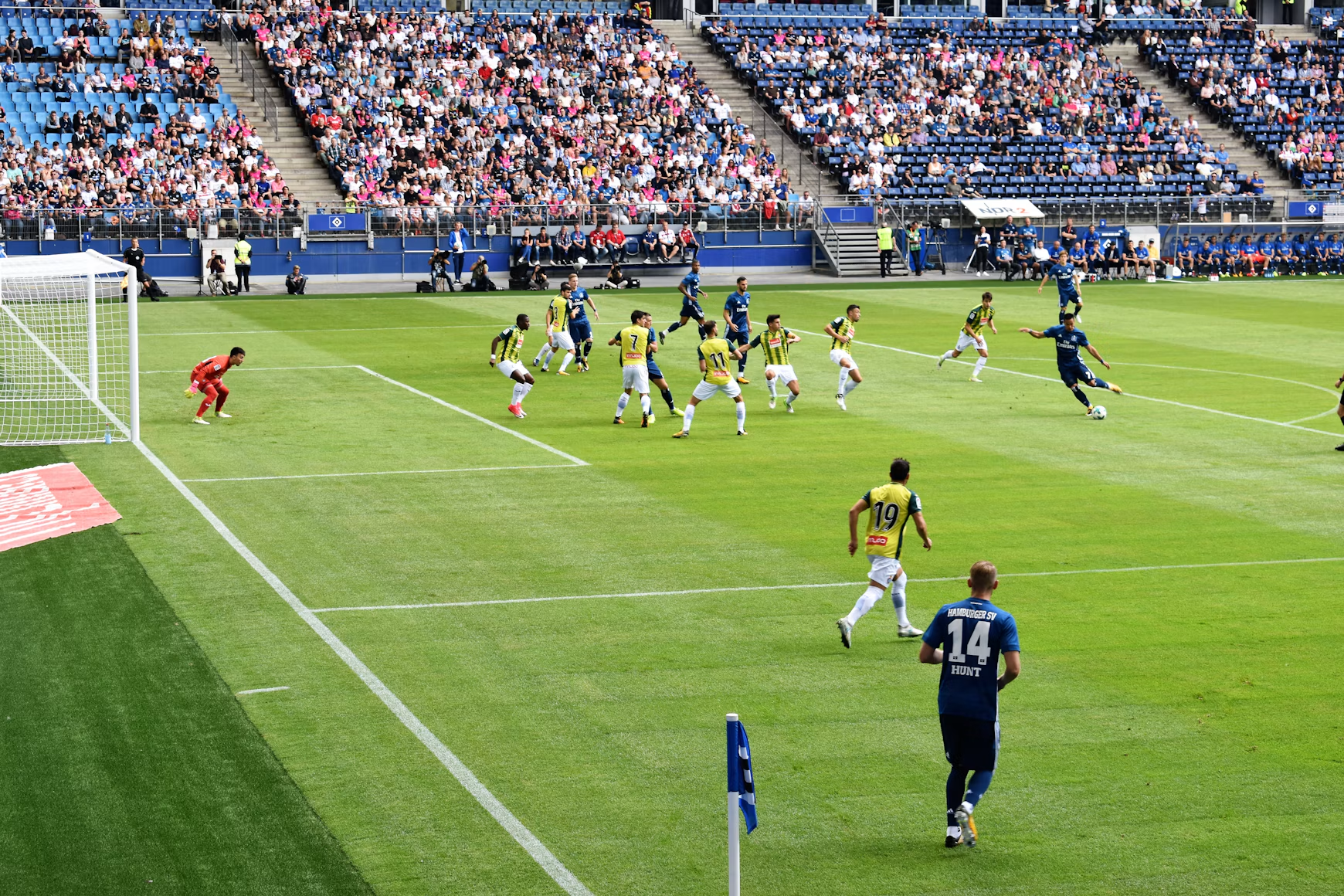
The ball drops near my box, an opponent picks it up, and before I've thought anything, my body has already moved.
That's the instinct, and it took me years to learn how often it's wrong. I used to be a forward, so I know what a dangerous run feels like before it starts. It's the only reason I'm any good at stopping them.
I moved back because I enjoyed reading the game more than finishing it. That, and the older I get, the more weight I gain. Since then I've spent years learning which of those moments are real.
Last week I wrote about reading the room: the defender who fills the gap before it opens. This is the other half. Once you can see everything, you still have to decide what actually matters.
Everyone starts out treating all of it as danger. You close the gap. You commit. You react to the fact that someone is there, rather than to what they're actually capable of doing with it. It feels like vigilance. Most of the time it's just noise dressed up as alertness.
The Instinct Isn't Distrust
Watch a back line long enough and most defenders look like they have trust issues. The moment danger shows up anywhere near the team, they react. I'm one of them. On the pitch I'm the loudest voice on my team: "man on", "time", "on your left", "get back", "focus". It could look like I don't trust the people around me. It's the opposite. Every call is me handing over what I can see so they can act on it.
From the stands, a defender who steps across to cover looks like he's saying "I don't think my fullback can handle this." He isn't. He's reacting to the presence of danger itself. Anticipating danger is the whole job, so the reaction is wired in. It fires at the threat, not at the quality of the person standing next to him.
That distinction matters, because it changes how you judge the instinct. The reaction isn't the flaw. It's what makes someone a defender in the first place. The real question is what happens in the half-second after it fires.
Not All Threats Are Threats
A good central defender spends their career learning to tell an opponent who is dangerous from an opponent who is merely present. This is called threat discrimination in performance psychology: correctly separating genuine danger from background noise, instead of reacting to everything with the same intensity.
Take a one-on-one with the goalkeeper. If the player running through is a centre-back who has wandered forward, that's usually the keeper's problem, and a calm one. (Usually. I've been that centre-back.) Nobody behind him needs to sprint back in a panic. Put a deadly striker in the exact same picture and everything changes: you recover, you cut the angle, you do whatever it takes to get there. The shape on the pitch is identical. The danger isn't.
Where does a threat actually start? Not at distance. Plenty of opponents stand right next to me and nothing happens. The line is whether you trust someone just to be near, or whether they might do something from there. For me, the tell is the eyes. A harmless one watches the ball. A dangerous one is looking past it, at the space, the gap, whatever's left unguarded. And everyone draws that line in a different place. Two defenders can share a back line and still mark at different distances. The shape only holds when each knows where the other one's line is.
Defenders who never develop this skill are easy to spot: constantly lunging, constantly stepping out of the line, treating every touch near them as a five-alarm fire. They're not more alert than everyone else. The panic is filling the gap where the judgment should be.
Trusting the Shape
Reading danger correctly is only half of it. The other half is trusting that you don't have to solve every problem on the pitch yourself.
A centre-back who reads the game well still has to resist a second instinct, subtler and harder to unlearn: the urge to cover everything. To drop deeper than you need to because you don't fully trust the midfielder screening in front of you. To check, again, a problem someone else already has. You've correctly identified there's no real danger yet. What's left is the urge to check anyway.
A back four doesn't work if one defender is quietly trying to defend all four positions at once. The system depends on a specific discipline: stay in your position, trust the player next to you to stay in theirs, and reserve your full attention for the moments that actually demand it. In that one-on-one, the keeper is the person you're trusting.
What This Looks Like Off the Pitch
This translates almost exactly to jealousy, and it's rarely framed this way.
When someone feels jealous, angry or frustrated, the usual assumption is that they don't trust the other person. Often that isn't it. The trust can be completely intact. What's reacting is the instinct, the same wired-in one as the defender's, firing at the danger around someone who matters to them: someone's attention, a new face in their circle, a pair of eyes looking for an opportunity, someone who seems to want something more. The feeling is about the presence of the danger, not a verdict on the person.
That makes the feeling normal. It doesn't make every situation a threat. Someone you care about talking to someone else isn't automatically a striker through on goal. Most of the time it's a centre-back wandering forward: a touch of the ball near the box that doesn't need anyone to lunge.
So the work comes after the instinct fires. It's reading which moments are genuinely significant, and then, for everything else, trusting the person you care about to hold their own position, without stepping out of yours to go check.
This isn't only one person's job. A defender can shout "man on" all day, but it only works if someone answers. "Got him." "Yours." The call and the answer are the whole system. Off the pitch it's the same. The one who feels the danger has to say it honestly, without accusing. The one being looked out for has to hear it and feel it first, before explaining why it's fine. Reasons come second. And sometimes protecting that feeling costs someone else a little comfort. Pay that knowingly, and look for the version that costs the least. How you answer is how the other person finds out the shape is holding.
It's harder than it sounds, because the two kinds of vigilance feel identical from the inside. Panicking at every touch and reading the game well both look, in the moment, like paying attention. The difference only shows over time: one version exhausts everyone involved, including the person doing it. The other lets the whole shape hold.
The Last Line Isn't Supposed to Move for Everything
The best defending is mostly invisible. Nobody writes about the tackle that didn't happen because the defender read the pass early and stayed where he was. Nobody notices the bond where nothing dramatic ever occurs, because neither person is spending energy checking the other for danger that was never there.
I can tell which runs matter because I used to make them. These days I'm slower than I was, so I read earlier, much earlier than I need to react. And the older I get, the less I react to what doesn't matter, because age adds knowledge and experience. Age doesn't make you faster. It makes you earlier.
Danger rarely announces itself. It arrives looking like nothing, and the only way to catch it is to know the difference between nothing and something.
I can shout all day, but without an answer I'm just a loud man alone at the back.
Not everyone who comes near is a threat. Learn which ones are. Shout when it matters. Hold your line when it doesn't. And trust the ones who shout back.