FIFA Forward, Football Backward
On the 19th of July 2026, Spain beat Argentina 1-0 in the World Cup final at MetLife Stadium — Ferran Torres scoring in the 106th minute to give Spain their second World Cup title. Gianni Infantino stood on the pitch alongside Donald Trump — the man he had awarded a specially invented prize two months earlier. The “FIFA Peace Prize” had not existed before Trump mentioned he was disappointed not to have won the Nobel.
Eleven days later, Infantino announced he was selling the World Cup.
Not all of it. Just the commercial operations — broadcast rights, sponsorship, ticket sales, licensing — bundled into FIFA Forward Enterprise, valued at $20 billion, with up to 20% available to private investors. The lead investor: Thrive Capital, founded by Joshua Kushner, whose brother Jared is married to Ivanka Trump. The person reportedly slated to run the new company as commissioner after Infantino’s FIFA presidency ends in 2031: Gianni Infantino, at approximately $64 million a year.
UEFA’s response, within hours: “It is not FIFA’s to sell. None of us are the owners of football.”
CONCACAF rejected it unanimously — including the United States, Canada and Mexico, the three countries that just hosted the $15 billion tournament Infantino was now proposing to monetise. Football Supporters Europe posted two words: “Game over, Gianni.”
What Infantino Is Actually Proposing
FIFA currently owns the World Cup as a non-profit. Every dollar it generates is redistributed back into football development across its 211 member nations. Infantino wants to create a new company that takes over the World Cup’s commercial operations — broadcast rights, sponsorships, ticket sales — then sell 20% of that company to private investors for $4 billion.
The moment that happens, the World Cup has a new constituency with a legal financial interest in its decisions. Private investors whose obligation is not to football but to their return. They do not need to develop the game in smaller nations. They need to maximise the profit of the asset they purchased.
UEFA named it precisely: “The World Cup cannot be treated as an investment product. It has been built over generations by players, national teams and supporters across every continent. No part of it should ever be surrendered to private investors. Football will never be for sale.”
The Structure of the Bribe
The plan requires a majority vote from FIFA’s 211 member associations. Infantino’s letter to all 211 included the following: approve FFE and your development funding doubles — from $10 million to $20 million per association.
By the following day, the offer had doubled again to $40 million.
That escalation is the most revealing detail in the story. Doubling within 24 hours is a textbook loss aversion response — when the initial incentive fails, increase the stakes rather than reconsider the premise. The only argument he has for this plan is a financial one, and when it wasn’t working, he made it larger.
Africa holds 54 of FIFA’s 211 votes — the largest continental bloc — and each association could receive up to $40 million if the plan passes. African federations are among the most financially constrained in the world. The path to approval was engineered to run directly through the nations least positioned to evaluate the long-term consequences of what they were approving.
CONCACAF’s statement contained the most damning line of the entire dispute: “Concacaf was only made aware of this matter through media reports and, subsequently, via a media release.” The confederation that hosted the tournament found out about the plan to monetise it from a press release.
The Transaction
Step back and look at what was exchanged across six months, and the Infantino-Trump relationship resolves into something cleaner than friendship.
What Infantino gave Trump: The invented FIFA Peace Prize. The overturned Balogun red card suspension. Maximum visibility at the most watched sporting event in history — sitting beside him at games, standing beside him at the trophy ceremony.
What Trump gave Infantino: Political cover for the Balogun decision. Connection to Joshua Kushner’s investment firm as the FFE deal’s anchor investor. Public endorsement as Trump’s preferred candidate for UN Secretary-General — describing Infantino as “respected by everyone around the world” with “a special ability to bring people together.”
The UN role is unlikely to materialise — the Security Council’s permanent members each hold a veto. But the endorsement is the point. This was never friendship. It was a transaction: two people using each other’s institutional power to advance their own interests, with the World Cup as the vehicle and the Peace Prize as the receipt.
Paul Piff’s research on power and rule perception explains the underlying psychology: people with sufficient institutional power do not experience rules as constraints. They experience them as suggestions — applicable to others, negotiable for themselves. The Balogun phone call, the invented award, the FFE plan — all of it follows the same logic. The rules apply until they don’t, and they stop applying the moment they become inconvenient.
The FFE plan was the transaction’s largest instalment — and the clearest expression of moral licensing: Infantino used the World Cup’s financial success as justification for a plan that would personally benefit him most. Good stewardship of the tournament became, in his framing, entitlement to profit from it. The relationship that produced the Balogun phone call was always heading somewhere. This is where it was heading.
Football Wins
It only took four days.
On Tuesday the 29th of July, Infantino announced FIFA Forward Enterprise. By Friday the 1st of August, he had scrapped it. UEFA threatened to boycott every FIFA competition. CONCACAF rejected it. The Asian Football Confederation rejected it. The UK Prime Minister condemned it. FIFA’s own chief operating officer told the Associated Press that staff had been “deceived” and “deserve better than contempt and intimidation.” His senior adviser resigned and called it “a bad deal for football.”
The opposition worked because it was unanimous and public — social proof operating in reverse. One federation saying no is ignorable. Ninety-six saying no in four days, including FIFA’s own senior staff, is not. Once the coalition formed, the cascade became unstoppable.
Infantino’s Friday statement: “Having listened carefully to all the views, it has become clear that the project has created divisions of a nature that, regardless of the level of support, are no longer in the interest of the objective set out in the first place.”
Translation: he ran out of road, he ran out of options.
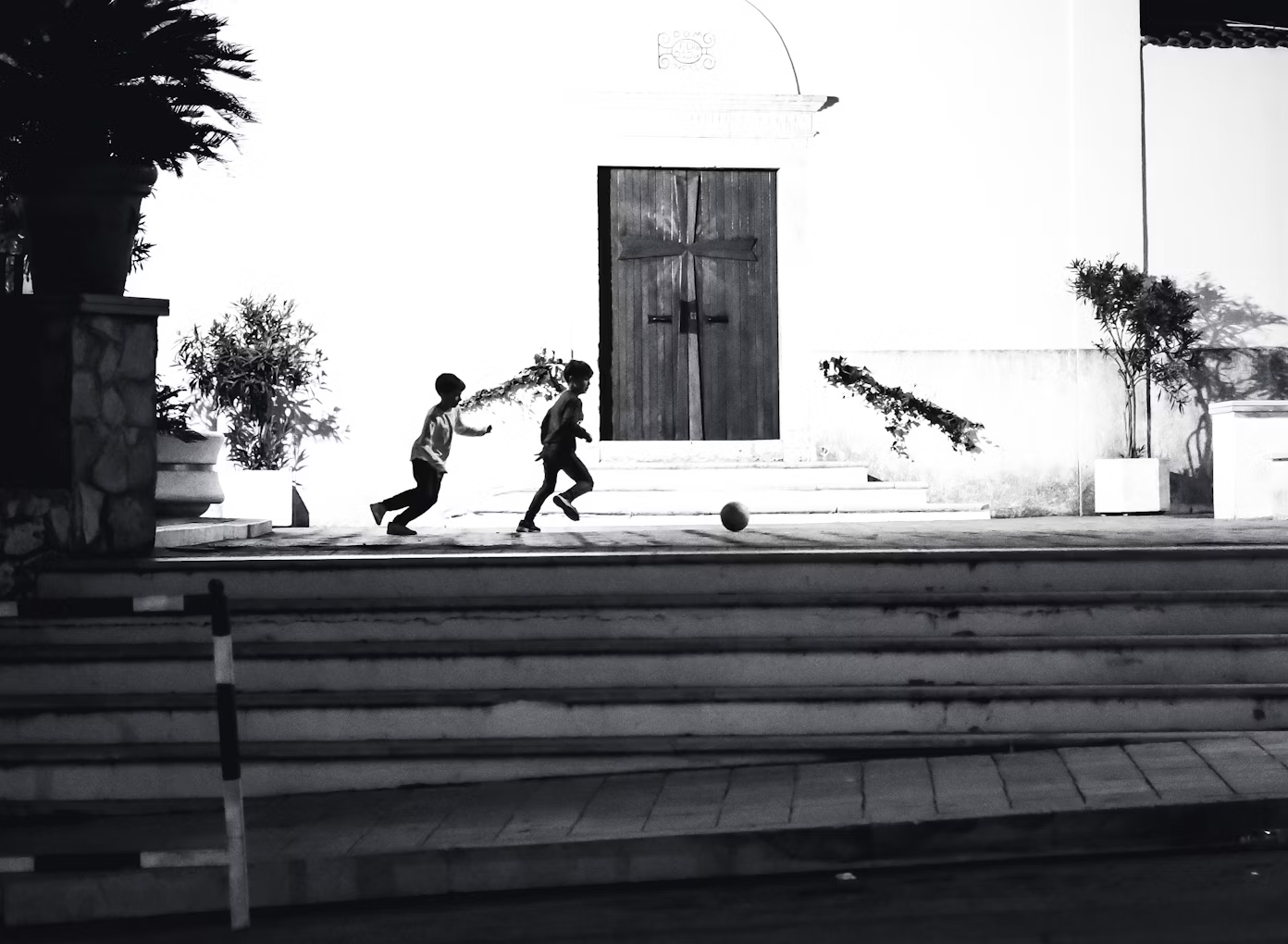
Football is a game created by people with nothing — played on streets and waste grounds long before any governing body existed to put its name on it. The World Cup belongs to the kid learning to play on a dirt pitch, the Sunday league player who has never watched a board meeting, the neutral fan who needed the rules to mean something. It does not belong to venture capital. It does not belong to anyone’s retirement plan.
Football is created by the poor, the streets. This week, the rich tried to steal it.
The game won. Football wins.
You've reached the juicy part of the story.
Sign in with Google to unlock the rest. It only takes 2 seconds.
Free forever. No credit card. Just great reading.