What Comes After Greatness
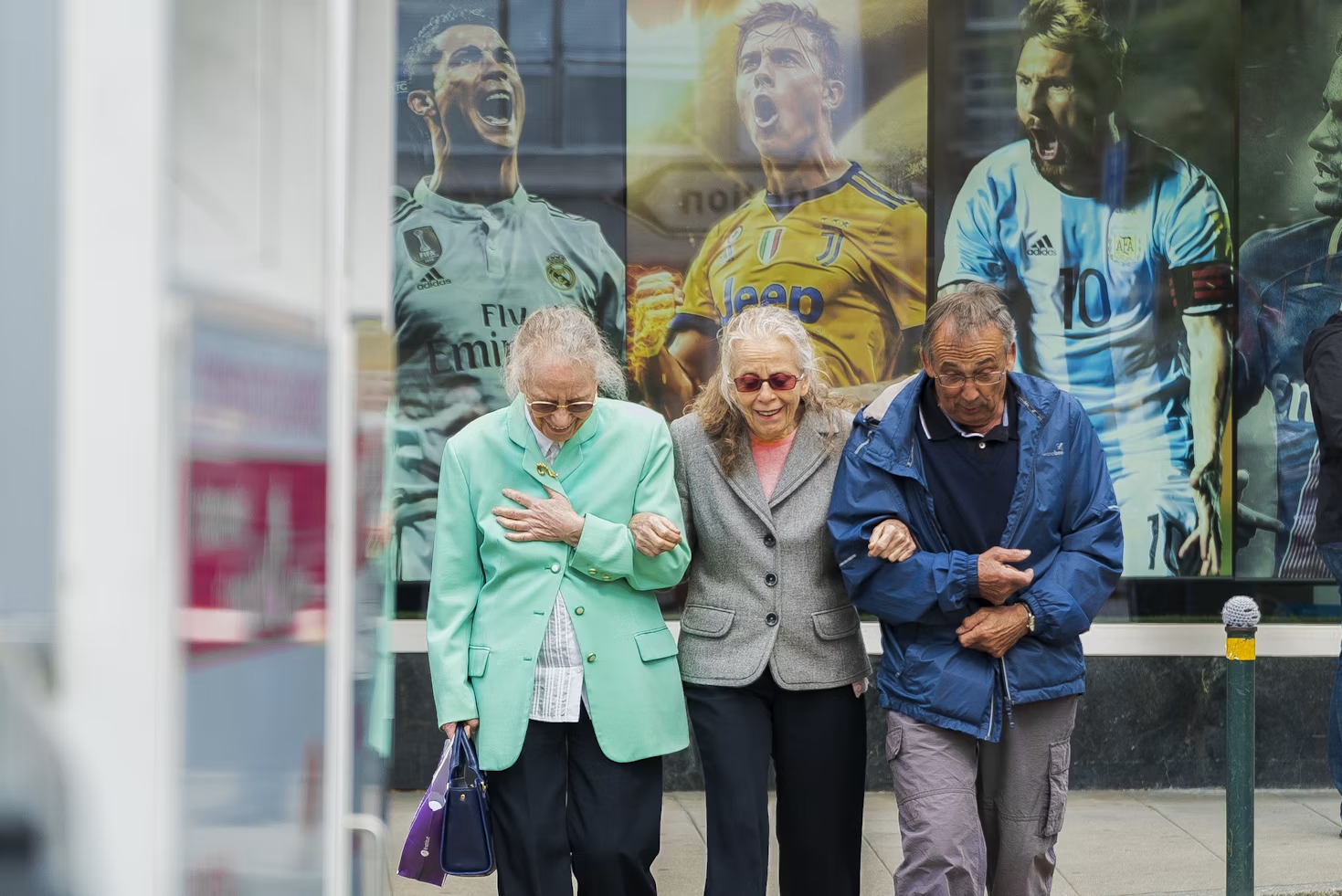
At some point — and nobody can tell you exactly when — the greatest person in their field becomes merely very good. Then good. Then someone younger arrives, and the cameras slowly pan away.
This is not a tragedy. It is just time. It happens to everyone.
But when you are Lionel Messi or Cristiano Ronaldo, when you have spent two decades being told — and genuinely believing — that you are the best human being alive at the thing you do, the arrival of that moment is not a gentle transition. It is a reckoning. And watching them navigate it, side by side, is one of the more quietly revealing psychological dramas in modern life.
Because they are handling it completely differently. And only one of them seems to be at peace.
What They Built
For roughly fifteen years, Messi and Ronaldo didn't just dominate their sport — they occupied a category of their own. The debate about who was better consumed entire television programmes, filled comment sections, divided families at dinner tables. They were not athletes who happened to be famous. They were a cultural phenomenon that happened to express itself through a ball.
With that came something harder to quantify than trophies: identity. For both men, the line between who they are and what they do was never really a line at all. When you are that, for that long, you stop being a person who plays. You become the game itself.
And then you age.
The Psychology of Letting Go
Psychologists have a name for what happens to powerful people who can no longer hold onto what once defined them: post-power syndrome. The symptoms are recognisable — difficulty accepting a new reality, an obsessive attachment to past achievements, a compulsive need to remain relevant, a quiet terror of becoming ordinary.
The crucial distinction is between positional power — status, authority, recognition, all external and removable — and personal power — values, relationships, a sense of self that exists independent of performance. The people who navigate this transition well built enough of the second kind to survive the loss of the first.
This is not just an athlete's problem. It is the CEO who cannot let go of the boardroom after retirement. The parent whose identity was so tied to raising children that the empty nest feels like an identity collapse. The expert who built their entire sense of worth around being the smartest person in the room. When the role disappears, the question that remains is always the same: who are you without it?
Ronaldo: The Refusal
Ronaldo's ego — the very thing that makes him difficult — is also the thing that made him extraordinary. He was not born the best. He built himself into it through a ferocity of will that bordered on irrational. The obsession with being the best is not a character flaw that produced greatness. It is the engine that built the greatness. You cannot separate the two.
And the world enabled it, for two decades. Every record celebrated, every achievement amplified. When the world tells you every day that you are irreplaceable, it becomes very difficult to hear the quiet evidence suggesting otherwise.
That evidence arrived with particular cruelty. At the 2022 World Cup, Portugal's manager dropped Ronaldo for a knockout match, handing the shirt to a 21-year-old who had barely played at international level. That player scored a hat-trick. Portugal won convincingly. The team had functioned brilliantly without Ronaldo at its centre. Time, which he had been holding at arm's length through sheer will, had made its presence known.
The pattern was already familiar. At Manchester United, he walked off the pitch before a match ended rather than accept a substitute's role. The manager dropped him. What followed was perhaps the most dramatic exit in modern sport — a television interview dismantling his relationship with the club, forcing a mutual termination of his contract. A move to Saudi Arabia came weeks later.
Some of his grievances were legitimate. But the pattern underneath — combustion when asked to accept a smaller role, the need to reassert centrality loudly and publicly — points to something deeper. A man for whom not being the most important person in the room is genuinely, psychologically intolerable. His identity fused so completely with his status that its absence feels like erasure.
This is post-power syndrome in its clearest form. Not a breakdown — but an unwillingness to release the identity that greatness built. It is the same pattern in any high-achiever who cannot step back gracefully: the executive who keeps interfering after handing over the business, the athlete who plays one season too many, the expert who cannot accept that the field has moved on. The summit has moved. Acknowledging that would require a renegotiation of self that feels too costly to make.
Messi: The Exhale
Messi's story is more complicated than it appears. He did not simply achieve greatness — he was shaped into a specific version of it by powerful institutions with enormous commercial interest in his success. From the moment he arrived as a teenager at one of the world's biggest clubs, a mythology was being constructed around him as much as by him.
Two moments in the same year illustrated the weight of that mythology. Aged nineteen, he scored a goal so extraordinary — picking up the ball near halfway, slaloming past five defenders in twelve seconds — that the press immediately compared it to the most famous individual goal in football history, scored by his legendary Argentine predecessor two decades earlier. Weeks later, he scored another goal, this time punching the ball into the net with his hand, almost exactly replicating his predecessor's most infamous moment from that same legendary match. In two months, he had recreated both — the sublime and the controversial. Football needed a successor to the legend, and Messi stepped completely into that role.
The pressure that came with it was immense. Every Argentina tournament became a referendum on whether he had finally surpassed the ghost he was being measured against. Every individual award carried its own controversies — questions about whether decisions were made on merit or on the commercial value of the name attached to them. He was not just a player who happened to be great. He was a product that powerful institutions had enormous interest in protecting and promoting.
And yet, underneath the machinery, something genuinely human was happening.
When Argentina finally won the World Cup in 2022 — the one trophy that had always been missing, the one that could silence every remaining comparison — something visibly left him. When he lifted that trophy and wept, it looked less like celebration and more like release. Twenty years of expectation, of carrying an entire nation's hope, of being measured against a predecessor's ghost — all of it seemed to leave his body in that moment.
What followed was telling. Not the biggest club, not the biggest contract, not one final attempt to prove something. He chose Florida. The beach. His family nearby. A quieter pace. His public persona had always been quieter than the mythology surrounding him — almost uncomfortable with the attention, never quite convinced it was the most important thing about him. Psychologists call this dual identity: a sense of self that exists alongside the public role rather than being consumed by it. When the role fades, something else remains.
The Same Destination, Two Different Journeys
Post-power syndrome, as psychologists describe it, is not about weakness. It is about what happens when the thing you built your entire identity around is no longer available in the same form — and whether you have enough of yourself left over to survive its absence. The people who navigate it well are not the ones who cared less. They are the ones who built enough personal identity alongside the positional one that when the position faded, something remained.
Messi built his greatness quietly. He did not campaign for his legacy — he accumulated it, incrementally, almost reluctantly. What that quietness suggests, in retrospect, is that the football was never the whole of him. The dual identity was always there — the person existing alongside the player, never fully consumed by the mythology surrounding him. When the World Cup arrived in 2022 and he finally lifted the one trophy that had always been missing, it did not feel like a coronation. It felt like a release. Permission, finally, to put something very heavy down. What came after — Florida, the beach, his children nearby, a slower pace — is not a retreat from greatness. It is the life of someone who had built enough of himself outside the game to know what to do when the game no longer needed everything he had.
Ronaldo built his greatness loudly. He announced it, defended it, performed it daily. And that performance — the discipline, the obsession, the refusal to accept any ceiling — was never separate from the achievement. It was the achievement. The positional power and the personal identity fused so completely that separating them now feels, from the inside, like self-erasure. Post-power syndrome does not announce itself as a crisis. It announces itself as a refusal — a determination to keep the identity intact by keeping the position intact, for as long as possible, against whatever evidence accumulates.
Ronaldo is still staring at the sun.
The thing about staring at the sun is that it does not feel like damage while it is happening. It feels like clarity — like being the only person willing to look directly at what everyone else shields their eyes from. The records still fall. The goals still go in. From the inside, it probably feels like proof. From the outside, it looks like someone who has not yet found a way to look somewhere else. That is not a moral failing. It is a very specific kind of courage that is also a very specific kind of blindness. The sun does not notice being stared at. Only the person looking pays the price.
This is not only a story about two footballers. It is the story of anyone who has ever built their identity so completely around what they do that the question of who they are without it becomes genuinely frightening. The executive who cannot retire. The parent whose identity collapsed when the children left. The expert who stayed too long because leaving meant admitting the chapter was over. Post-power syndrome does not require a stadium or a trophy. It just requires having cared deeply about something, for long enough, that its absence leaves a shape you do not know how to fill.
Messi found something to fill it with. Quietly, on his own terms, before anyone was watching.
Ronaldo is still looking for the answer in the place where the question began.
Both are entirely human. And that, more than any debate about who was better, is what makes their story worth following to the very end.