Garuda di Darahku
In March 2025, a survey of 1,200 Indonesians found that 71.5 percent approved of naturalising foreign-born players for the national team. When asked separately whether there were now too many of these players in the squad, 31.5 percent of respondents said yes.
The word doing most of the work in that survey is "naturalising," and it is, for most of the players this conversation is actually about, the wrong word.
There is a real difference between a state granting citizenship to someone with no ancestral claim to the country, and a state recognising the citizenship that a person's bloodline already entitled them to, even if the paperwork is only now catching up. Indonesia has examples of both. Cristian "El Loco" Gonzalez, the Uruguayan-born striker who became one of the country's most beloved adopted sons in the 2000s, had no Indonesian ancestry whatsoever — no parent, no grandparent, nothing in his blood that connected him to the archipelago before he arrived. He qualified through years of residency and marriage to an Indonesian woman, and Indonesia's citizenship law allowed the federation to convert that residency into a national team shirt. That is naturalisation in the full sense of the word: a state manufacturing eligibility for a talented outsider, because the law permitted it and the football was worth it.
Almost none of the current wave fits that description. Jay Idzes, Mees Hilgers, Ole Romeny, Joey Pelupessy, Mathew Baker, Shayne Pattynama — every one of them already had an Indonesian parent or grandparent before a single conversation with the federation took place. The blood was never in question. What was missing was the citizenship, and in most cases, the active choice to claim it. Calling this "naturalisation" makes it sound identical to the Gonzalez pathway — a country recruiting outside talent and processing the paperwork to make it eligible. It isn't. It is closer to the opposite: a country's diaspora, scattered by migration and colonial history rather than ancestry, choosing — for the first time in their lives, in most cases — to formally become what their family tree always said they already were.
These are not really two slices of the same pie — they come from different questions entirely, which is exactly what makes them worth sitting with. A person could easily answer yes to both: broadly support the policy, and still feel uneasy about how far it has been taken. Indeed, the same survey found 54.5 percent had no issue with the current numbers as long as results kept improving, while a smaller 13.5 percent rejected the policy outright. Overlapping, sometimes contradictory positions, all held by the same population in the same week.
They are, taken together, the most honest possible snapshot of a country that loves what the policy has produced and is not entirely sure it loves the word being used to describe it.
What Actually Happened
The mechanism is not complicated, even if the feelings around it are. FIFA allows a player to represent a country other than the one they were born in, hold citizenship of, or have long resided in, provided a parent or grandparent was born there. Indonesia, with an enormous diaspora in the Netherlands dating back to Dutch colonial rule, has more eligible players abroad than almost any nation that has used this rule.
Under coach Shin Tae-yong and later the federation leadership of Erick Thohir, Indonesia began actively recruiting them. Jay Idzes, whose maternal grandparents were born and raised in Indonesia. Mees Hilgers, with Indonesian roots through his mother from Manado. Maarten Paes, a former Dutch youth international goalkeeper who became Indonesia's hero in a World Cup qualifier. Shayne Pattynama, who has spoken about representing Indonesia as a way of honouring his late father's Moluccan heritage. By 2025, a provisional national squad was reported to be 63 percent diaspora-eligible.
The results were immediate and real. Indonesia passed the group stage at the Asian Cup. They reached the semi-finals of the U23 Asian Cup. They came closer to World Cup qualification than at almost any point in the country's footballing history. For a fanbase that has spent decades watching the national team underachieve relative to the country's size and passion for the sport, this was not a minor shift. It was the first sustained taste of competence in a generation.
The wave has not slowed. In early 2025, four more players took the oath of citizenship within weeks of each other — striker Ole Romeny, a Dutch youth international with an Indonesian grandmother who thanked Indonesia's president personally for making the process possible; goalkeeper Emil Audero, on loan from Italian football; defensive midfielder Joey Pelupessy, whose Indonesian descent runs through his Moluccan father; and Dean James, who took the same oath the same week. PSSI was simultaneously courting Mitchel Bakker, the Lille left-back with an Indonesian grandfather, as a further reinforcement to the defence — a sign that the federation views the diaspora pipeline not as a one-off project but as an ongoing, almost permanent recruitment strategy.
The Three Stories Indonesia Tells Itself
Academic researchers who studied Indonesian media coverage of the policy found something worth taking seriously: the conversation does not split into simple support and opposition. It splits into three distinct, overlapping frames — frames that, tellingly, tend to use the word "naturalisation" themselves even when discussing players who are really exercising a diaspora claim rather than being recruited from nowhere.
The first frame treats diaspora players as national assets — a pragmatic, even patriotic solution to a structural problem. Indonesia is a country of nearly 280 million people that has historically punched far below its weight in football, hampered by chaotic youth development and years of administrative dysfunction. In this frame, recruiting players with Indonesian blood who were trained in Dutch academies is not a shortcut. It is simply a faster, smarter way to access talent that, in a fairer world, would already belong to Indonesia by descent.
The second frame is built on skepticism about authenticity — the suspicion that these players do not feel what a player who grew up dreaming of the national team feels. This frame does not usually deny that the players have Indonesian blood. It questions whether blood is the same thing as belonging. A player who was born in Tilburg, trained in a Dutch academy, and only learned of his Indonesian grandmother's hometown as an adult is, in this view, a different category of Indonesian than the player who grew up in Surabaya idolising the team he later joined.
The third frame is about what gets lost — concern that leaning on the diaspora pipeline, however effective in the short term, comes at the cost of developing the country's own footballing infrastructure. Why build academies, invest in coaching, and be patient with a generation of homegrown talent, when a faster route to results exists in the Eredivisie's reserve squads?
All three frames are visible in the same week of coverage, sometimes in the same article. This is not a country that has made up its mind. It is a country actively negotiating, in public, what it means for a stranger with the right grandparent to wear the same shirt as the players who were born wanting to wear it.
The Voice From Inside the Policy
The most interesting perspective on this does not come from a pundit or a politician. It comes from one of the first players who ever went through the process.
Stefano Lilipaly and Sergio van Dijk were among the earliest of this diaspora wave to play for Indonesia, years before the current generation made the pathway mainstream. Van Dijk, who still follows Indonesian football closely and refers to the country as "we," has expressed real sympathy for the broader project while raising the same concern that researchers identified independently: "There are definitely downsides. My main concern already was we are looking at results... the local players could feel demotivated at this moment, not having a chance to make it or having a very difficult chance to make it into the national team."
This is not the voice of an outsider dismissing the project. It is the voice of someone who benefited from it directly, who still wants Indonesia to succeed, and who is nonetheless naming the exact tension the country has not resolved: that a policy built to close the gap with the rest of Asia might be quietly widening a different gap, between the players who are flown in to fix the problem and the players who were already there trying to grow into the solution.
The Colonial Layer Nobody Can Fully Set Aside
There is a historical layer to this that makes the Indonesian case different from, say, the various Gulf states' programmes of naturalising athletes with no ancestral connection to the country at all — the El Loco pathway, exported and scaled.
The overwhelming majority of this diaspora generation were born in the Netherlands — the country that colonised Indonesia for over three centuries and fought a brutal war to prevent its independence. In 2022, the Dutch prime minister formally apologised after a government-commissioned study confirmed the Dutch military had used what the report called "systematic and extreme violence" during Indonesia's fight for independence. That history sits, mostly unspoken, underneath every conversation about a national team now built substantially from players developed in Dutch academies, carrying Dutch passports until the moment they chose otherwise.
Some commentators have read this as an uncomfortable irony — a nation reaching back into the colonial relationship that once denied it sovereignty, in order to build the team that now represents that sovereignty on a football pitch. Others read it differently: as a quiet, almost poetic reversal, in which the descendants of people who were displaced or who emigrated under colonial-era conditions are now choosing, entirely voluntarily, to return their footballing talent to the homeland their grandparents left. Both readings can be true of the same player at the same time.
Blood, Passport, and What Belonging Actually Requires
Underneath all three media frames, and underneath the colonial history, sits a single psychological question that the policy forces every Indonesian fan to answer for themselves, whether they realise it or not: what actually makes someone belong to a place?
Is it where you were born? Most of this diaspora generation were not born in Indonesia. Is it where you were raised, where your habits and instincts and first football memories were formed? By that standard, they belong to the Netherlands, not Indonesia. Is it blood — the simple, undeniable fact of a grandmother from Manado or a grandfather from Makassar, carried forward into a body that grew up an ocean away? This is the standard the diaspora pathway is built on, and it is also the standard that media skepticism most often pushes back against, because blood alone has never been enough to satisfy most people's intuitive sense of belonging.
Or is it something closer to what Shayne Pattynama described — not a fact about where you are from, but a choice about where you decide your story has to go. Pattynama did not claim Indonesian citizenship simply because his bloodline allowed it. He claimed it, by his own account, because it was a way of honouring a father who was no longer alive to see it. That is not a fact about geography. It is an act of will.
This is probably the most honest answer the country has access to. Claiming the citizenship makes the legal belonging possible. It does not, on its own, manufacture the emotional belonging that turns a player in an unfamiliar stadium into someone the crowd around him recognises as theirs. That has to be built separately, match by match, through performance and visible commitment and the slow accumulation of a player choosing, repeatedly, to mean it.
Some of these players will do that work and become as beloved as anyone who grew up dreaming of the shirt. Some will not, and the doubt the skepticism frame voices will turn out to have been justified in their specific case. The pathway cannot guarantee which outcome any individual player will produce. What it can do — what it has already done — is give a country that spent decades underachieving something it had rarely had before: a reason to believe, even if the belief is complicated, even if 31.5 percent of the country thinks there might now be too much of a good thing — and even if "naturalised" was never quite the right word for what most of them actually are.
What It Looks Like From the Inside
The word the conversation keeps using is "naturalised." And it is still the wrong word — not just as a technicality, but as a description of what actually happened. Naturalisation implies a state granting something to someone who did not previously have it. What Indonesia has been doing with this wave of players is closer to the opposite: recognising something that was always already there. The blood existed before the passport. The eligibility existed before the federation made the call. The paperwork caught up to a fact, rather than manufacturing one.
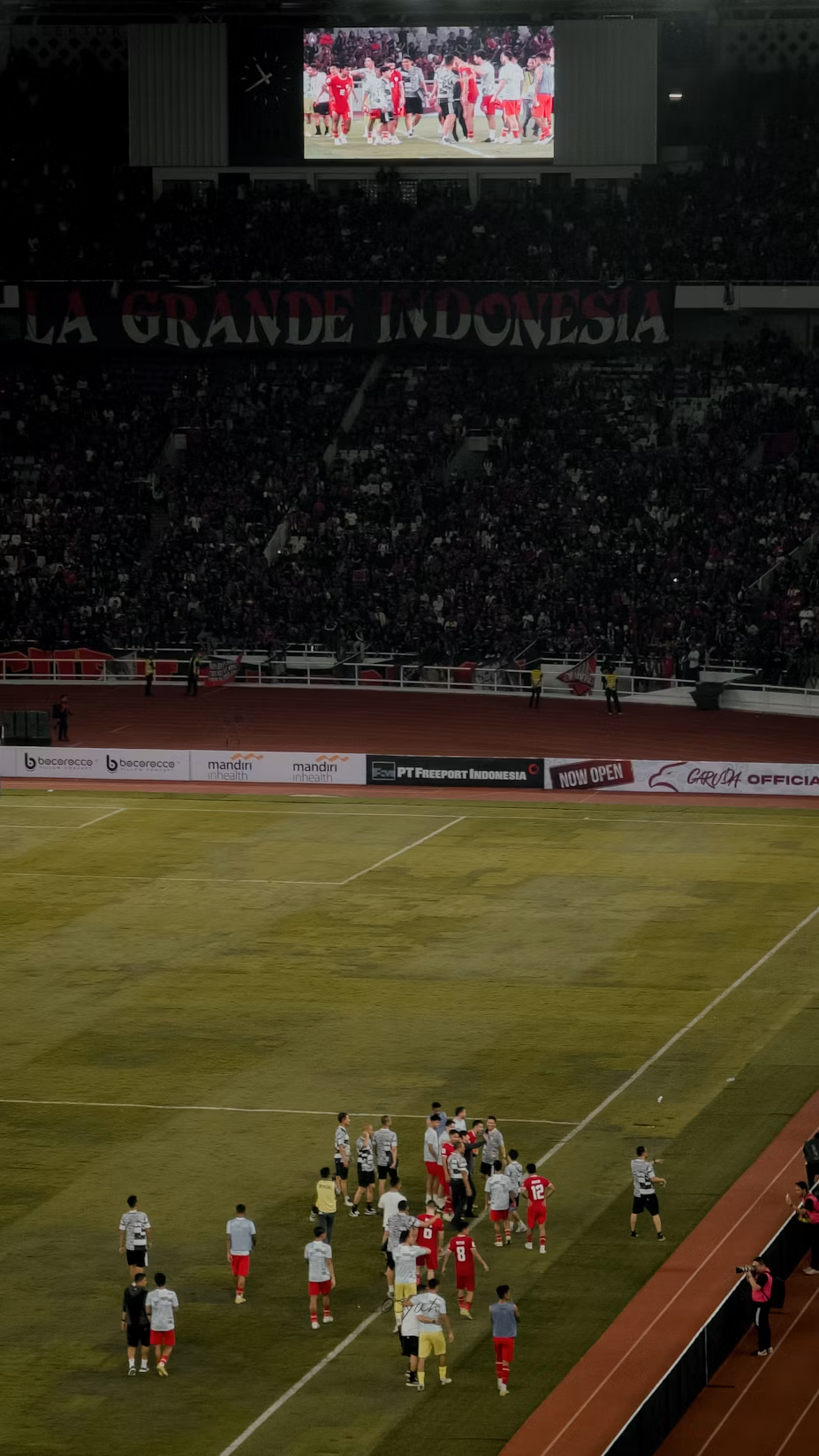
On the 5th of June 2026, at Gelora Bung Karno Stadium in Jakarta, a seventeen-year-old defender named Mathew Baker came off the bench during Indonesia's 3-0 win over Oman and became the youngest player ever to debut for the senior national team. That night, he posted to Instagram: "Indonesia, there are no words that can truly describe how proud I am to make my debut for my country. Last night is a memory that will last a lifetime."
No survey statistic, no media frame, no academic argument explains that sentence better than the sentence explains itself. Baker did not become Indonesian on the day he took the oath. He always was. That is what separates this wave from naturalisation in the way the word is usually meant — from El Loco Gonzalez arriving from Uruguay with no ancestral claim, from the Gulf states processing foreign athletes with nothing more than residency and ambition. This is not a state manufacturing eligibility. This is a state recognising something that was always already true.
The debate will continue. The question of what belonging actually requires — blood, upbringing, feeling, choice — will never be fully settled, because it is not a question with a clean answer. Countries have been wrestling with versions of it for as long as they have had borders and the people who move across them.
But Baker on that pitch in Jakarta, at seventeen, in a red and white shirt, is the whole argument made visible. Not naturalised. Not recruited. Not processed. Just — finally, formally, officially — home.