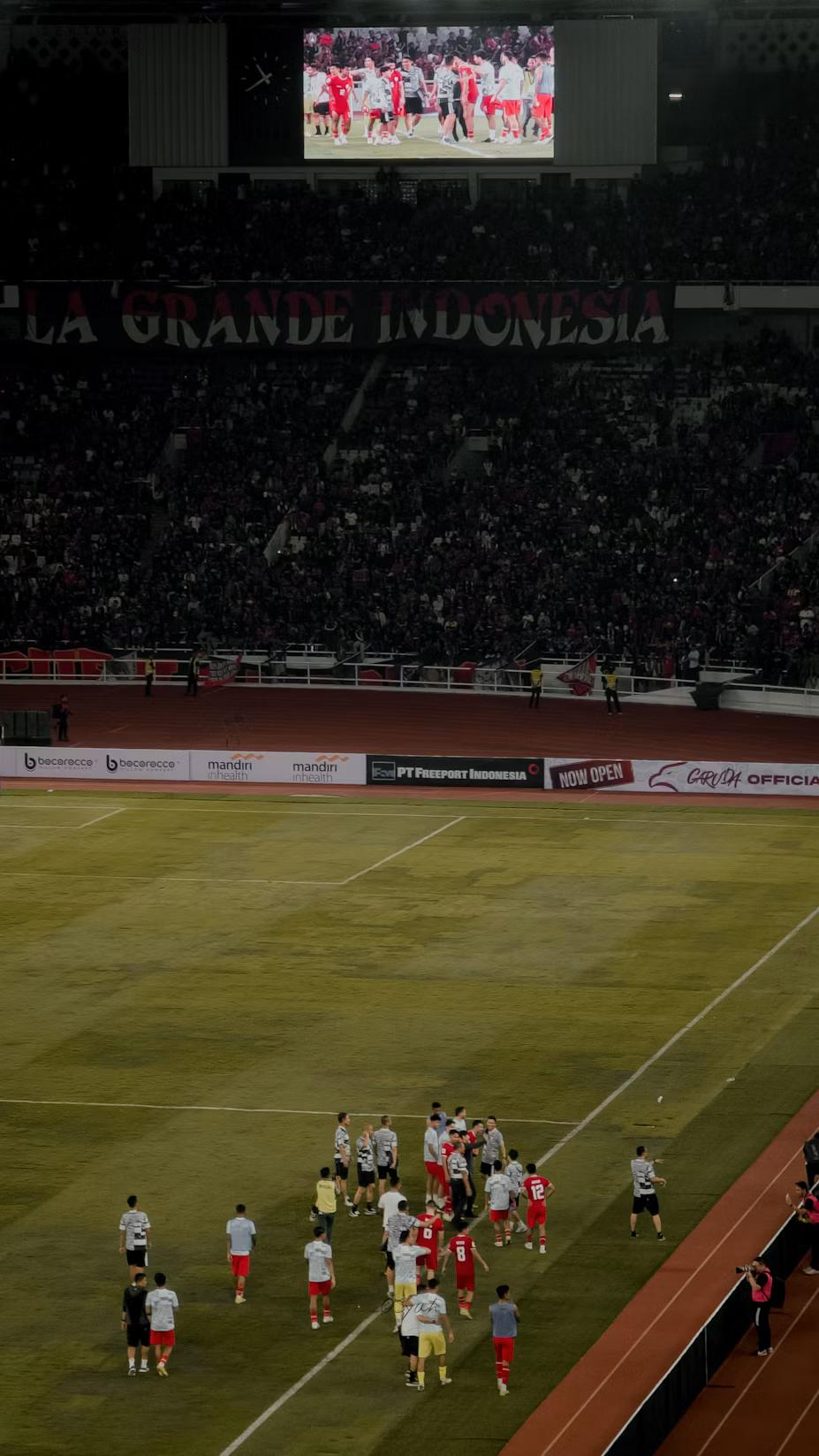
I watched a padel match recently between the world's best pair and two opponents who never had a chance. The scoreline ended 6-0, 6-1. For most of it, the crowd was quiet in the specific way crowds go quiet when the outcome stopped being in doubt somewhere around game four of the first set.
Then, somewhere in the second set, the losing pair broke serve. Won a game. The score moved from something like 4-0 to 4-1.
The crowd applauded.
I have not stopped thinking about that applause since. It was not loud. It was not particularly long. But it was, without question, one of the saddest sounds I have heard at a sporting event — and I could not work out, in the moment or since, exactly what it meant. Was it support? Consolation? Was some portion of it, uncomfortably, amused? The players on the losing side could not have known either. They just received the noise, the way applause is always received: as a single undifferentiated signal, with no way to unpack what was inside it.
The Assumption We Never Examine
Applause seems like the simplest communication system in sport. Something good happens, people clap, the volume and duration roughly track the size of the thing that happened. A tap-in gets polite acknowledgment. A wonder-strike gets a roar. The system appears to have one input and one output, and everyone involved seems to agree on what it means without ever discussing it.
This is mostly true, and it is also almost completely wrong, because applause is not one signal. It is a single physical gesture — hands meeting, repeated, at some volume — that gets used to encode at least half a dozen structurally different, and sometimes directly contradictory, emotional messages. The gesture stays the same. What is inside it changes constantly, and the person receiving it has no reliable way to tell which version they just got.
The Many Things a Clap Can Mean
Genuine celebration is the baseline everyone assumes. A goal, a winning shot, a moment of real quality, applauded in proportion to how good it actually was. This is the version of applause that requires no further thought, which is exactly why it sets the expectation for every other version.
Narrative satisfaction is a different thing entirely. When Robin van Persie scored for Fenerbahçe against Manchester United, years after leaving the club as one of its most decorated forwards, the reaction from the crowd was not primarily about the technical quality of the finish. It was about a story landing correctly — the ageing player, the homecoming, the proof that something still worked. A fairly ordinary goal can receive an extraordinary ovation if the story around it is heavy enough. The crowd is applauding meaning, not skill.
Relief from tension shows up most clearly in a penalty shootout. The save, the miss, the moment the unbearable waiting resolves into something — the applause that follows is not really about the quality of the save. It is the discharge of accumulated anxiety that had nowhere else to go.
Compassionate applause is the padel match. The crowd is not celebrating a return to competitiveness — the match, by that point, had none left. They are acknowledging, in the only language a crowd has, that the losing side is still human, still trying, and does not deserve to be completely erased by the scoreline. This is applause directed at the person rather than the performance — a way of saying we see you, and we are sorry, and also we would like this to feel slightly less brutal for everyone involved, including us.
Social obligation is the emptiest version — the polite clap at the end of something forgettable, present only because stopping would feel conspicuously unkind. It carries almost no individual meaning. It exists because groups conform, and silence in that moment would say more than anyone wants to say out loud.
Applause as apology happens when a crowd that turned on a player earlier in a match — booing a poor touch, groaning at a misplaced pass — applauds generously the moment he does something good. Part of that applause is genuine. Part of it is a crowd quietly making amends for what it said fifteen minutes earlier, without ever having to admit that's what it's doing.
Applause as farewell is the standing ovation for a substituted player nearing the end of a career. It is rarely about the specific ninety minutes just played. It is decades, arriving all at once, in one sustained sound that has almost nothing to do with what just happened on the pitch.
The Gap Nobody Can See Across
Here is the part that makes this genuinely unsettling rather than just an interesting taxonomy: the person receiving the applause cannot tell which version they are getting.
The losing padel pair, hearing that applause after finally winning a game, had no way to separate genuine warmth from pity from the small, uncomfortable possibility that some of it was quiet amusement at how far they'd fallen behind. The signal arrives identical regardless of source. Hands meeting at a certain volume for a certain duration. The emotional content — celebration, relief, compassion, apology, obligation — is invisible from the outside, encoded in a gesture that has no dialect for distinguishing between them.
This is social signaling ambiguity — the gap between what a signal is intended to communicate and what the receiver actually experiences. Humans built an entire communication system around a physical action — the clap — treating it as if it reliably transmits a single, legible emotion, when in fact it is closer to a universal container that can carry almost anything, including things that contradict each other inside the same thirty seconds.
The recipient is left doing the interpretive work alone, usually under conditions — public performance, competitive pressure, personal exposure — that make careful interpretation the last thing they have capacity for. A losing player, mid-match, hearing an ambiguous ovation, does not get to pause and workshop what it might mean. They absorb it instantly, as encouragement or pity or something in between, and play the next point regardless.
Why This Matters Beyond Sport
The same ambiguity exists everywhere applause exists — the office presentation clapped through by colleagues who are relieved it's over rather than impressed by its content, the parent applauding a child's mediocre performance because withholding it would be a different kind of cruelty, the retirement speech applauded partly for the years and only partly for the speech itself.
Nobody examines this closely because examining it would make an enormous number of ordinary, well-intentioned social moments considerably more awkward than they currently feel. It is easier to let the gesture do its work unexamined — to let a clap be a clap — than to ask, every time, what exactly is being communicated and whether the person on the receiving end is getting anything close to what was intended.
But every so often, a scoreline gets lopsided enough, or a career ends publicly enough, or a moment becomes narratively loaded enough, that the ambiguity becomes impossible to ignore. The clap sounds exactly the same as it always does. And for one uncomfortable moment, everyone in the room quietly wonders what it actually meant — including, most of all, the person it was for.
misterillahi•Sep 20, 2026 In 2003, the German newspaper BILD ran a headline about Sebastian Deisler that said everything about how professional football thought about mental health at the time: "Deisler back in Psycho-clinic."
Deisler was a German international of genuine promise — technically gifted, creative, the kind of player who arrives once in a generation and makes everything around him look easier than it is. He had disclosed, at enormous personal cost, that he was receiving psychiatric treatment for depression. The headline used the word "psycho" the way it is used as an insult rather than a clinical term. The message was not subtle: mental illness in a professional footballer was a story of weakness. A scandal, not a tragedy.
Deisler retired at 27. Not because of physical injury, not because the quality had gone, but because the illness and the environment around it had made continuing feel impossible. He gave one remarkable interview years later, describing what it had actually been like — the concealment, the performance, the exhausting daily effort of appearing fine to an institution that had no language for what he was experiencing. He said: "I simply couldn't go on anymore."
Nobody in that dressing room had known.
What Depression Actually Does
The word is used casually enough that it has lost some of its precision. Sadness, low mood, a difficult week — all of it gets described as depression in ordinary conversation, in ways that make the clinical condition seem more manageable than it is.
Clinical depression is not sadness. It is a specific disruption of the brain's chemistry — affecting mood, cognition, motivation, and physical functioning simultaneously, in ways that can make the ordinary demands of daily life feel genuinely impossible. The depressed person does not simply feel bad. They lose access to the feeling of things mattering. The future stops feeling real. The people around them — even the most loved ones — become strangely distant.
Andrés Iniesta described this with a specificity that most clinical descriptions cannot match. While winning a Champions League and preparing to score the most famous goal of his career at the 2010 World Cup, he was in the worst period of his life — depression that had descended following the death of his closest friend, Espanyol captain Dani Jarque, who died of a heart attack at 26. "I hugged my wife," Iniesta said, "but it was like hugging a pillow. I didn't feel anything."
He described the best part of the day being when he could take his medication and go to sleep. He described the feeling as: "You feel that it's not you, that you don't enjoy things, that the people around you are just people. You have no feelings or passion. You end up feeling empty inside."
He was, during this period, one of the best footballers in the world. Performing at an elite level, in front of millions of people, while privately experiencing something that made the inside of his life unrecognisable. The performance and the illness existed simultaneously, with almost no visible intersection. This is the part that surprises people most, and it is the part that is most important to understand: depression does not announce itself in the way we expect illness to announce itself. It does not reliably reduce performance. It does not make itself visible in the ways the culture has trained us to recognise.
Per Mertesacker described vomiting before almost every match throughout his entire career at Arsenal — severe anxiety that the dressing room, the coaching staff, and the public never saw. He only spoke about it after retiring. "Before every game I was in such a state," he said. "I could barely walk. I was throwing up." The man collecting Premier League winner's medals and representing Germany at World Cups was, simultaneously, the man who could barely make it through a pre-match routine.
Why Football Is a Particularly Difficult Environment
Professional football is not a uniquely dangerous environment for mental health in the sense of causing depression in people who would not otherwise experience it. Depression does not work that way — it interacts with biology, circumstance, and personal history in ways that cannot be reduced to a single cause.
What football does is create an environment in which depression is uniquely difficult to acknowledge, seek help for, and recover from.
Performance determines survival. A footballer with depression who seeks treatment, takes time out, or discloses their condition to club medical staff is risking their place in the squad. Not because clubs are universally unsympathetic — the culture has improved significantly since the Deisler headline — but because the logic of professional sport is that the person who performs is the person who plays. There is no equivalently high-stakes context in most ordinary workplaces. You can take sick leave for a physical illness and return to your role. A footballer who misses months with depression may return to find the position they held no longer exists.
Identity is entirely contingent on performance. Most people have multiple sources of identity — their work, their relationships, their interests, their communities. For an elite footballer, identity is concentrated almost entirely in the football. Who they are, how they feel about themselves, how others regard them — all of it is routed through how they play. When depression makes playing feel impossible, or makes playing feel meaningless, it does not just affect the footballer. It affects the entire structure of who they believe themselves to be.
What Iniesta's Goal Actually Was
On the 11th of July 2010, in extra time of the World Cup final in Johannesburg, Andrés Iniesta scored the goal that gave Spain its first World Cup. He turned from the celebration, pulled up his shirt, and revealed a vest with four words written on it: Dani Jarque, siempre con nosotros. Dani Jarque, always with us.
He said afterward that it was the moment he "felt like a footballer again." Not the goal itself, not the trophy, not the World Cup — the act of carrying his friend's name into that moment and making it visible. The depression had not been cured by winning the World Cup. It had been treated, professionally, carefully, with the help Iniesta had been able to seek when he recognised he needed it. What the goal gave him was not recovery. It was a moment of meaning that had been, for a period, entirely inaccessible.
What Changed, and What Hasn't
The Deisler headline is the kind of thing that would end a journalism career today. By 2024, Germany had a network of 70 sports psychiatrists specifically trained to work with athletes. Professional clubs in the Premier League now employ performance psychologists. Aaron Lennon was supported through a public mental health crisis in 2017 without the career-ending stigma that would have followed in an earlier era. Marvin Sordell retired at 26 and spoke openly about what the sport had cost him mentally. The language has changed. Players can now say the word.
But the structural conditions that make depression particularly difficult to disclose and treat in professional football have not changed as much as the conversations around them. The selection pressure is still there. The identity concentration is still there. The dressing room is more aware, more sensitised, more likely to treat a struggling teammate with genuine care — and it is still, fundamentally, a competitive environment where performance determines survival.
What remains is the gap between being able to say the word and building an environment where the structural incentives genuinely change — where a player in crisis can step back from the demands of performance without the step back also being a step toward the end of their career.
For Someone Specific
This piece was written with someone in mind. Not a professional footballer. Just a Sunday league striker — the kind who had no business dribbling past anyone and knew it, whose first touch occasionally let him down, who couldn't pass and didn't pretend otherwise. But he had something that can't be coached: the instinct of knowing where the ball was going to arrive before it got there. The right place, every time, without thinking. A Chicharito type. The cheeky number 9 who scored goals he had no right to score because he was always, somehow, already exactly where he needed to be.
He is gone now. There were goals, and there was a lot more than goals — the version of him that showed up every week, made people laugh, made a Sunday league pitch feel like somewhere worth being.
This piece is for him.
He is one person. But the broader pattern discussed here is not rare. It runs through the history of football in ways the sport has been slow to acknowledge, and through the lives of people who never played professionally, who carried something similar through their own ordinary version of the same performance.
The illness is invisible in a way that a knee injury is not, that a hamstring strain is not, that almost any physical condition is not. It hides behind the performance that the professional demands of the player. It conceals itself in the dressing room banter and the pre-match routine and the post-match interview. It carries the person who is carrying it through the normal obligations of professional life, for weeks or months or years, and the person carrying it does so because the alternative — disclosure, vulnerability, acknowledgement — feels more dangerous than the illness itself.
It is not a weakness. It is not a failure of resilience. It is an illness. And the sport that produced Sebastian Deisler, and Andrés Iniesta, and the countless others who have carried it quietly through careers the public watched without knowing — that sport is still, in important ways, working out what it means to take that seriously.
If you or someone you know is struggling with depression or difficult feelings, please reach out to a mental health professional or a trusted person in your life. You do not have to carry it alone.
misterillahi•Sep 12, 2026 In the summer of 1999, Ronaldo Nazário stood in the tunnel at the Stade de France and prepared to play a World Cup final. Four years earlier he had been the most electrifying footballer on the planet. Then two knee surgeries and a patella operation that at one point threatened his ability to walk normally. The body that produced those performances was gone. What replaced it was rebuilt, functional, but not the same.
He scored twice in the final. Brazil won 2-0.
It's one of the great comeback stories in football. It's also a story about what it costs to return, and what players do with the fear that never fully leaves.
What the Body Carries
Physical recovery has a clear timeline. Psychological recovery does not — it runs alongside the physical process and long after it, mostly invisible.
Repression — pushing uncomfortable feelings out of conscious awareness — is the default in football culture. Show weakness and you lose your place. So fear goes underground, and what goes underground in the mind tends to surface through the body: hypervigilance in challenges, subtle avoidance, disproportionate frustration at minor setbacks. The medical clearance has been given. The body is structurally sound. But it remembers what happened to it, and hasn't been consulted about forgetting.
Luke Shaw, after his horrific 2015 leg break, said the psychological battle was harder than the physical one. The leg healed. The mind took longer.
The Helmet and the Hiding
There are two ways to return from serious injury: hide what happened, or wear it.
Petr Cech chose the second, and it was more radical than it appeared. After a 2006 collision fractured his skull, he wore a protective helmet for every remaining match of his career — over a decade, every appearance. The helmet wasn't just precaution. It was the most public possible acknowledgment of what happened, built into his identity so completely it became inseparable from who he was as a goalkeeper.
What followed — Champions League winner, most clean sheets in Premier League history — came from the version of himself forged in that recovery. The trauma was integrated rather than suppressed, and on the other side of that was a player performing without the cognitive cost of pretending.
The Players Who Returned Different
Ronaldo Nazário was never again the player who terrorised defenders pre-surgery. What returned was heavier, slower off the mark. He couldn't pretend otherwise — the change was visible to everyone. So he renegotiated: more positioning, more reading of the game, relying on technical precision that had always been there beneath the athleticism.
This is post-traumatic growth applied to athletic identity — not returning to who you were, but building something new from what remains. It's the harder path, because restoration is the story everyone prefers. Renegotiation requires grieving who you were before becoming who you are now, and football's culture rarely accommodates that grief.
Roy Keane took the other path. After his 1997-98 ACL tear, his return was followed by one of the great individual Champions League performances — the 1999 semifinal against Juventus, carrying United to a final he'd be suspended from. Unchanged, undiminished. This case exists. It's not the norm.
The Body Keeps the Score
Emotions aren't just feelings — they're physical events. Heart rate, muscle tension, hormones, happening simultaneously with the feeling, not after it.
Repress an emotion and you block its psychological expression, but the physical response already started and doesn't stop because the mind decided not to engage. It keeps running, quietly, for as long as the repression holds. The body can't tell an acknowledged fear from a buried one — both produce the same response. The acknowledged one resolves. The buried one just keeps going.
For a returning footballer, buried fear of re-injury produces chronic tension around the original injury site — the body guarding what it remembers, even mid-performance. Over time this shifts load, creates compensatory patterns, and increases injury risk from an entirely new source.
Research on ACL re-injury confirms this directly: players who processed the fear rather than just suppressing it had significantly lower re-injury rates than players who were physically cleared but psychologically unresolved — identical test results, different outcomes. Chronic unresolved stress also elevates cortisol, which suppresses immune function and slows recovery. The player pushing fear down and getting back on the pitch isn't being strong. They're being expensive, and the cost compounds.
The Life Parallel
Everyone has returned from something — not necessarily a fractured skull, but the experience of resuming a role that demands continuity while something inside has changed. The return to work after a loss. The relationship resumed after a breach of trust. The project restarted after public failure. All of them negotiate the same gap: what the situation demands (normalcy, an uninterrupted self) against what's actually true (someone who's been through something they haven't finished processing).
Football just makes this visible. The recovery is documented, the return is public, and the body's response is recorded in every match.
The lesson isn't that fear can be eliminated. Ronaldo was afraid. Shaw was afraid. Cech, standing in goal for the first time after a fractured skull, almost certainly was too. The lesson is what they did with it — pushed down and paid for later, or acknowledged and integrated.
The body remembers what happened to it. The question is whether the mind allows itself to remember too.
The break was not the end. The return was not a return to before. It was something new, built on the ground of what survived.
In 2004, on Brazilian television, Ronaldo Nazário said something that most footballers think and almost none say out loud.
"I have had sex several times before some games. It helps you concentrate. Not all the coaches let you have sex before a match though. I have noticed that in some games that I played better because I had sex before them."
A World Cup winner, three-time World Player of the Year, stating plainly that one of the oldest taboos in sport had no hold over him — and that, if anything, the opposite was true. Ten years later, at the 2014 World Cup, four national federations would publicly disagree with him. All four would be home before the quarter-finals.
The Ban That Keeps Coming Back
Before the 2014 World Cup in Brazil, Bosnia and Herzegovina, Chile, Mexico, and Russia all imposed restrictions on sexual activity during the tournament. Bosnia's coach Safet Susic was characteristically blunt: "There will be no sex in Brazil. They can find another solution, they can even masturbate if they want. I am not interested what the other coaches do, this is not a holiday trip, we are there to play football." Mexico's coach Miguel Herrera offered a similarly unimpressed defence of his own ban: "Nobody has died from practising abstinence for 40 days."
These were not fringe positions. They sat inside a belief that has existed, in some form, since ancient Greece — that sexual activity, and ejaculation specifically, draws something vital away from an athlete's body. Roman and Greek trainers preached abstinence as a path to athletic purity. The belief survived because it felt intuitively true, not because anyone had ever tested it.
All four of the abstinence nations were eliminated by the round of 16.
This proves nothing on its own — eliminations happen to good and bad policies alike — but it is the kind of detail that earns a place in the conversation precisely because of how neatly it lands.
What the Science Actually Says
The honest answer, for most of football history, has been: nobody properly checked. Sports science largely avoided the question, partly from squeamishness and partly because rigorous studies are hard to design around something this private.
That has started to change. A systematic review covering decades of available research, published in Frontiers in Physiology, found that sexual activity does not measurably affect testosterone levels in the short or long term, and that no consistent effect on athletic performance — positive or negative — could be demonstrated across the existing literature. The myth of depletion, in other words, had never actually been supported by evidence. It had simply been repeated until it sounded like fact.
A more recent and considerably more rigorous study went further. Published in Physiology & Behavior, researchers followed 21 well-trained male athletes through a randomised crossover design, comparing performance thirty minutes after a masturbation-induced orgasm against performance following seven days of abstinence. The result directly contradicted the centuries-old assumption: exercise duration increased by 3.2 percent, testosterone and cortisol both rose rather than fell, handgrip strength improved slightly, and markers of muscle stress actually decreased. The researchers proposed that sexual activity may function as a kind of physiological primer — activating the same sympathetic nervous system response that a conventional warm-up does, releasing endorphins that reduce pain perception, and increasing motivation and confidence in the process.
None of this means sex makes anyone a better athlete by default. The sample size is small, the subjects were all young trained men, and the researchers themselves caution against overreaching. But the directional finding is consistent and clear: there is no evidence that sexual activity weakens performance, and there is now reasonably good evidence that, for some athletes, it does the opposite of what coaches have assumed for over a century.
Ronaldo Nazário was not making an excuse. He may have been describing something real.
Why the Myth Survived Anyway
If the evidence does not support abstinence, why has the belief lasted this long, across cultures and centuries, repeated by coaches who have no scientific basis for repeating it?
Part of the answer is psychological rather than physiological. Pre-competition rituals — including abstinence — function as a form of perceived control. An athlete facing an outcome they cannot fully determine reaches for any variable they can manage. Diet, sleep, superstition, sexual abstinence: all of it offers the same psychological service, regardless of whether it does anything measurable to the body. If a coach believes abstinence sharpens focus, and communicates that belief with total conviction, the belief itself can produce a kind of placebo discipline — not because semen retention does anything biologically, but because the ritual of self-denial signals seriousness, and seriousness is genuinely useful.
There is also a less flattering explanation, and it deserves more than a passing mention. The abstinence belief was never really about testosterone. It is about who gets to decide what a male athlete's body is for, and it rests on a specific, old idea: that a man's sexual desire is a finite resource, that spending it is a form of weakness, and that a coach — not the athlete — is the correct authority to manage that resource on his behalf.
Sit with what Susic's rule actually asked of his players. Forty days. Not a headache, not a minor inconvenience — forty days of watching his partner across a room in the team hotel and being told the wanting itself was the problem. Forty days of a body doing exactly what bodies do, and being informed that the doing was a discipline failure. "They can even masturbate if they want." Not encouragement. Not neutrality. A grudging allowance, delivered with visible contempt, as if the ache itself were an indulgence that had to be tolerated rather than a basic human need. The implication is that even release, alone, in private, is something a coach permits rather than something a grown man is entitled to.
That is not sports science. That is a specific, gendered idea about discipline — the belief that denying the body what it wants is itself a form of moral and competitive superiority, and that a real professional proves his seriousness by how much he is willing to give up, regardless of whether giving it up does anything at all.
No equivalent rule has ever targeted sleep deprivation from a crying newborn, or the anxiety of a new relationship, or grief. Only sex. Only pleasure. The selectivity is the tell.
The WAGs Problem
If the men's side of this story is about abstinence and superstition, the other half of football's relationship with sex is about the women connected to the players — and it tells a different, considerably less flattering story.
The term WAGs entered football culture around the 2002 World Cup and exploded into the mainstream by 2006 in Germany, when the British press constructed an entire parallel narrative around the wives and girlfriends of the England squad — their shopping, their nightlife, their proximity to the team hotel treated as a subplot worthy of equal coverage to the football itself. The framing was rarely flattering. WAGs were positioned as distraction, as decadence, as evidence that a team's focus had drifted from the only thing that was supposed to matter.
The logic curdled further by 2022. When Germany were eliminated in the group stage in Qatar, a German tabloid ran the headline "What is actually wrong with our WAGs?" — blaming the squad's partners for insufficiently energetic partying, while crediting England's WAGs, who had reportedly been livelier, with somehow contributing to England topping their group. The implied mechanism was never explained, because there isn't one. It was scapegoating dressed up as sports analysis: easier to blame the women in the stands than the eleven men who lost on the pitch.
Look at both halves of the story together and the double standard is stark, and it is not subtle. Men are told that sex might weaken them, so the correct response is abstinence — desire treated as a threat to be managed and rationed by someone else. Women, meanwhile, are blamed for not being entertaining or energetic enough to inspire their partners to perform — desire treated as a resource they are responsible for supplying on demand. One half of the story punishes women by casting them as a danger. The other half punishes women by casting them as a service. Neither version holds the players accountable for their own performance. Both versions find a woman to blame first.
What both halves of this story share — the abstinence rules and the WAGs blame cycle — is the same underlying instinct: control the variable that feels controllable, assign it outsized causal power, and use it to explain outcomes that are actually decided by far more mundane factors like fitness, form, and the quality of the opposition.
What Actually Matters
Strip away the myth and what remains is something almost absurdly intimate: a grown man, a professional athlete at the physical peak of his life, forbidden from touching the person he loves. Not told to rest. Not told to recover. Told no — to the ache of wanting her, to the warmth of her skin against his after weeks apart, to the release that every other human body on earth is permitted without a coach's signature.
Picture it plainly. She has flown across an ocean to be near him. The hotel room is fifty metres away. Every instinct in his body — the same instinct that made him extraordinary on a pitch, the desire, the hunger, the refusal to hold back — is suddenly the one thing he is told to suppress. Not because his body needs it. Because a man in a tracksuit believes, without evidence, that wanting her too much will cost him something on Saturday.
The 2026 research says the body was never built to punish him for this. It never withheld strength as the price of intimacy. Ronaldo Nazário knew that instinctively in 2004, before anyone had bothered to check.
It is also worth asking, honestly, who the ban actually serves. It costs a federation nothing to impose. It requires no investment, no infrastructure, no expertise. And if the team performs badly afterward, the ban becomes retroactively useful — evidence, however unfounded, that whatever went wrong was a discipline problem rather than a tactical or physical one. A coach who bans sex has manufactured himself an excuse before the tournament has even started. That is not a coincidence. That is a remarkably cheap form of insurance, purchased at the expense of the players' autonomy and, if the science is right, their actual performance.
Football has always been comfortable asking players to give things up. It has been considerably less comfortable asking whether the things it asked them to give up were ever actually costing them anything — or whether the real function of the sacrifice was never physiological at all, but a story a coach could tell afterward about why the team lost.
misterillahi•Aug 30, 2026