The Seven Corners That Ended a 22-Year Wait
Inside the matches where Nicolas Jover's set-piece machine actually decided Arsenal's 2025-26 Premier League title. His precise deliveries from set-pieces were instrumental in Arsenal's triumph in the 2025-26 Premier League season, marking the end of a22-year wait for the title.

A coaching appointment, July 2021
When Arsenal hired Nicolas Jover from Manchester City in July 2021, the announcement barely registered. He was a 39-year-old French set-piece specialist, lured across London on the back of Mikel Arteta's connections from his own time as Pep Guardiola's assistant. The hiring of a specialist coach for one phase of play was unusual but not headline-grabbing. Arsenal had finished eighth the season before. There were bigger problems than corners.
Five seasons later, Jover's name is the answer to one of the most consequential questions in modern Premier League history: how did Arsenal end a 22-year title drought in a season where their open-play attack was, by Mikel Arteta's own admission, not good enough to win the league?
The answer is seven matches. Seven moments. Seven corners — or set pieces close enough — that turned almost-certain draws and losses into wins. Sixteen points. The exact margin between a championship and a 23rd year of waiting.
This is the story of those seven moments.
17 August, Old Trafford — Calafiori, minute 13
It is the opening day of the season. Arsenal have not won at Old Trafford against Manchester United in the league since September 2020. The match is still in its first quarter when Declan Rice steps up to take an inswinging corner from the left. Altay Bayindir, Manchester United's goalkeeper, comes for it, flaps, and misses. Riccardo Calafiori is six yards out and unmarked. The header is almost a formality.
Without that goal, Arsenal probably draw 0-0. Open-play chances are scarce; Bayindir would not be tested in any meaningful way for the rest of the match. The corner is the difference. Counterfactual cost: two points. Running total: 2 dropped.
29 September, St James' Park — Gabriel, minute 90+5
Arsenal have lost their last three visits to Newcastle. They are losing this one too, until the 84th minute, when Mikel Merino glances in a Rice cross to make it 1-1. Then deep into stoppage time, a corner from the right. Gabriel Magalhães — who had been partly at fault for Nick Woltemade's opener — rises and heads home from a corner. He sprints to the away end with his arms wide.
Without that goal, Arsenal draw 1-1 in a match they were losing twenty minutes earlier. Counterfactual cost: two points. Running total: 4 dropped.
18 October, Craven Cottage — Trossard, minute 58
Fulham have been a bogey side for years. The first half is dire — Arsenal cannot get into the game, and Saka admits afterwards that his early corner deliveries were "rubbish." Then, in the 58th minute, one isn't. Saka's inswinger finds Gabriel at the back post. Gabriel flicks it on. Leandro Trossard, lurking, knees it over the line from close range.
It is Arsenal's 50th goal from a corner since the start of the 2022-23 season. No other Premier League side has more than 34 in that period. Arsenal win 1-0. Without the corner, they draw 0-0 — Fulham don't muster a shot on target all game. Counterfactual cost: two points. Running total: 6 dropped.
26 October, Emirates Stadium — Eze, minute 8
This one bends the definition slightly. A free-kick is delivered into the Crystal Palace box. Palace head it clear. But the ball drops to Eberechi Eze — playing his first home league match against his former club — and Eze meets it with a left-footed scissor kick. Top corner.
Some statisticians wouldn't call this a set-piece goal. Most, including Opta, would: the entire sequence originated from a dead-ball delivery, and the second-phase recovery is part of how Arsenal's set-piece routines are designed. There is nothing else in the match. Arsenal win 1-0; without Eze's strike, 0-0. Counterfactual cost: two points. Running total: 8 dropped.
13 December, Emirates Stadium — Saka and Saka again
Wolves are bottom of the table and Arsenal cannot break them down. The 70th minute arrives with no goal. Then Saka swings in a corner that ricochets off the post, hits goalkeeper Sam Johnstone in the back, and rolls into the net. Recorded as an own goal. But it came from Saka's corner.
Wolves equalise through Tolu Arokodare in the 90th minute. The Emirates groans. Two minutes into stoppage time, another Saka corner. This one deflects off Wolves defender Yerson Mosquera. Own goal. 2-1.
Both of Arsenal's "goals" are own goals from Saka corners. Without them, Arsenal lose 0-1 to the team that will be relegated in May. Counterfactual cost: three points. Running total: 11 dropped.
1 March, Emirates Stadium — Saliba and Timber
Chelsea are third when they visit the Emirates. Saliba opens the scoring from a Saka corner, headed across goal by Gabriel. Just before half-time, Hincapié inadvertently flicks a Reece James corner into his own net to equalise. Chelsea start the second half on top. Then, in the 66th minute, Timber meets a Rice corner and Robert Sánchez — caught between coming and staying — appears to duck under it. 2-1.
Pedro Neto is sent off shortly after for a second yellow. Chelsea cannot recover. But the structure of Arsenal's win is unmistakable: two goals, both from corners. Without them, 0-1 loss to a top-four rival. Counterfactual cost: three points. Running total: 14 dropped.
18 May, Emirates Stadium — Havertz, minute 37
The title is one win away. Burnley are already relegated. The Emirates is anxious — Saka has appealed for a penalty and been denied, Trossard has hit the post, Eze has clipped the crossbar. Then Saka takes a corner. Havertz times his run from deeper space, rises unchallenged in the six-yard box, and heads it down into the net.
It is Arsenal's 18th goal from a corner in the Premier League season — a new competition record. It is also the only goal of the game. Arsenal win 1-0; the title is mathematically clinched the following Tuesday when Manchester City drop points at Bournemouth. Without the Havertz header, the match ends 0-0 and the title race goes to the final day. Counterfactual cost: two points. Final total: 16 dropped.
Sixteen points
Arsenal finished the 2025-26 Premier League season on 82 points, four clear of Manchester City. Strip those sixteen points away — strip those seven moments away — and Arsenal end the season on 66.
That puts them third. Behind Manchester City on 78. Behind Manchester United on 68. Above Aston Villa on 62.
Three goals from corners. Two own goals from corners. One header from a cleared free-kick. One late corner deep in stoppage time at St James' Park.
Seven moments. One coach. One title.
What Jover actually does
The mechanics of Jover's work have been picked apart endlessly. Late runs from deep positions to exploit zonal-marking gaps. Blockers occupying defenders to free runners. Specifically designed routines for specific opponents. Second-phase positioning so that if the first ball is cleared, Arsenal are in the right spots to win the recovery.
But the more interesting thing about Jover's contribution is what it tells us about where the marginal value of coaching lies in elite football. In a Premier League where top teams are tactically and physically converged, where every side presses and counter-presses and has a possession structure, the differences between teams in open play are vanishingly small. A great open-play coach might buy a side an extra goal every three or four games over a season. That's worth a lot, but it is incremental.
A great set-piece coach can buy you a goal in a match where you would otherwise have scored zero. Not an extra goal — a goal where there would have been none. That is a categorically different kind of value. It is the difference between making good teams better and making good teams win.
Arsenal won eight 1-0 matches in the Premier League this season, their second-most in a campaign behind only 1998-99. Five of those eight 1-0 wins involved decisive set-piece goals. The team's identity — defensive solidity plus set-piece reliability — was specifically the identity of a team built to convert the tight matches that decide titles.
A note on luck
It is worth saying clearly: not all of these seven moments are pure coaching. Bayindir's flap at Old Trafford is a goalkeeper error. Johnstone's ricochet against Wolves is partly fortune. Sánchez ducking under Rice's corner is a moment of confusion as much as a moment of design. Arsenal benefited from things going their way.
But this is true of every champion. Manchester City would not have won six of the previous eight titles without Ederson having occasionally spectacular days. Liverpool's 2019-20 was built partly on a few set-piece goals from Virgil van Dijk that found their target through margins of inches. The question is not whether luck plays a role — it always does — but whether your tactical structure is designed to maximize the matches in which luck matters.
Arsenal's set-piece structure forces goalkeepers into more difficult decisions. It puts more bodies in the six-yard box than opponents can comfortably mark. It rebounds off more legs because there are more legs in the way. The seven moments above are not all "Jover did this." But they are all moments where Jover's system created the conditions under which they could happen.
A 22-year wait
The last time Arsenal won the league, in May 2004, they did it as the Invincibles — unbeaten, attacking, beautiful. Thierry Henry scored 30 league goals. Robert Pires scored 14. Freddie Ljungberg scored four. The whole side functioned as an open-play organism.
The 2025-26 Arsenal will be remembered differently. They will be remembered as the set-piece kings, the team that perfected the dark art of the corner, the side that made Premier League goalkeepers afraid of the inswinger. There is a slight ambivalence in the way this title has been received — some commentators have written, with varying degrees of grace, that Arsenal won it by exploiting a tactical loophole rather than by being the best team in open play.
That criticism mistakes what football is. Football is a game in which goals decide matches and matches decide titles. There is no extra credit for the way you score. A header from a corner counts the same as a curling shot from 25 yards. Arsenal scored 24 goals from set pieces in the league. Their rivals did not. That is not an exploit. That is a coaching decision, executed brilliantly, over the course of an entire season.
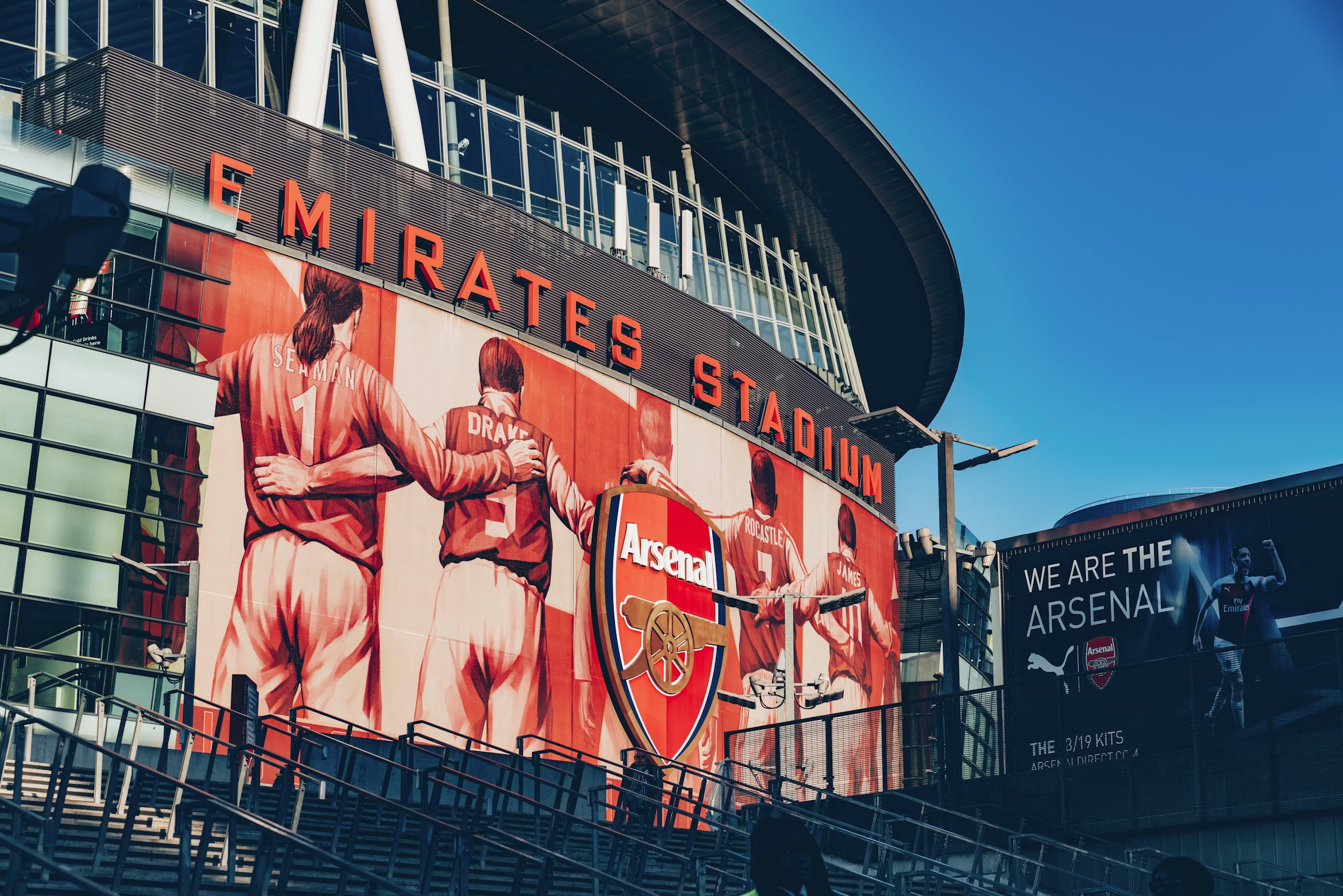
Seven of those goals decided seven matches. Those seven matches were the difference between champions and bronze-medallists. Nicolas Jover, hired in obscurity in July 2021, may be the most consequential coaching appointment in English football this decade.
The corner kick, that humblest of dead balls, was the weapon. Arsenal were the team that pointed it correctly.
Sources: match reports from The Athletic, ESPN, Sky Sports, Opta Analyst, Arsenal.com, BBC, and Wikipedia's 2025-26 Arsenal F.C. season page. Final Premier League standings from NBC Sports. Methodology and counterfactual analysis based on a static-counterfactual model — i.e. assuming all other match events held constant.
You've reached the juicy part of the story.
Sign in with Google to unlock the rest — it takes 2 seconds, and we promise no spoilers in your inbox.
Free forever. No credit card. Just great reading.